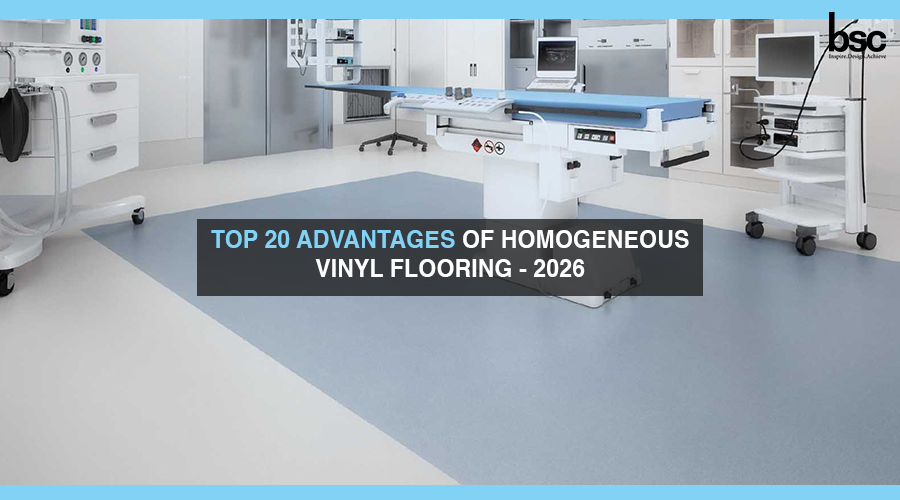
Choosing flooring for a commercial project is not only about colour, pattern or first impressions. The floor may need to handle thousands of footsteps, wheeled traffic, furniture movement, frequent cleaning and demanding day-to-day operations while maintaining a professional appearance.
That is where homogeneous vinyl flooring continues to be a practical option in 2026.
Homogeneous vinyl flooring is commonly manufactured as a single-layer or mono-layer resilient flooring material. Unlike heterogeneous vinyl, which generally combines several layers including a printed design layer and wear layer, homogeneous vinyl has a consistent construction throughout its thickness.
This construction makes it particularly relevant for healthcare facilities, educational institutions, offices and other high-traffic commercial environments where durability and straightforward maintenance are important. Major commercial flooring manufacturers such as Tarkett offer homogeneous vinyl specifically for demanding applications.
So, what makes homogeneous vinyl flooring worth considering?
Here are the top 20 advantages of homogeneous vinyl flooring in 2026.
What Is Homogeneous Vinyl Flooring?
Homogeneous vinyl flooring is a resilient flooring product with a composition that is essentially consistent throughout its thickness. It is commonly available in sheet and, depending on the collection, tile formats.
Commercial homogeneous sheet flooring is generally bonded to a properly prepared subfloor, with joints capable of being welded according to the flooring system and installation specification.
Because the material does not depend on a separate printed decorative layer in the same way many heterogeneous products do, it is particularly suited to environments where long-term surface performance matters.
Top 20 Advantages of Homogeneous Vinyl Flooring
Here’s the breakdown of all 20 Advantages of Homogeneous Vinyl Flooring :
- Excellent Durability for High-Traffic Areas
- Consistent Construction Throughout the Floor
- Strong Resistance to Wear and Abrasion
- Easier Day-to-Day Cleaning
- Suitable for Healthcare Environments
- Ideal for Educational Facilities
- Good Resistance to Stains
- Can Reduce Intensive Maintenance Requirements
- Suitable for Large Commercial Projects
- Wide Choice of Colours and Patterns
- Supports Creative Zoning and Wayfinding
- Helps Create a Continuous Floor Appearance
- Specialist Options Are Available for Static-Controlled Areas
- Low-VOC Options Are Available
- More Sustainable Product Options Are Emerging
- Can Offer Good Lifecycle Value
- Suitable for Areas with Rolling Loads
- Acoustic Variants Can Improve Sound Comfort
- Coordinates Well with Modern Commercial Interiors
- Versatile Across Multiple Commercial Sectors
1. Excellent Durability for High-Traffic Areas
The biggest advantage of homogeneous vinyl flooring is durability.
Commercial buildings can experience constant movement from employees, visitors, trolleys, chairs, equipment and other rolling loads. Flooring therefore needs to withstand more than occasional residential foot traffic.
Manufacturers specifically develop homogeneous flooring for demanding environments. Tarkett, for example, describes its compact homogeneous vinyl as suitable for heavy and very heavy traffic areas, while Polyflor markets homogeneous ranges as high-performance commercial flooring.
For projects where flooring is expected to remain in service for years, this durability can become a major specification advantage.
2. Consistent Construction Throughout the Floor
The defining feature of homogeneous flooring is its mono-layer construction.
The material remains consistent through its thickness rather than relying solely on a thin decorative wear surface.
This gives architects, consultants and project teams a flooring solution designed around long-term functional performance.
It is one of the primary reasons homogeneous vinyl is frequently considered for institutional and commercial projects where floors face intensive daily use.
3. Strong Resistance to Wear and Abrasion
Commercial flooring frequently experiences scratching, abrasion and gradual wear caused by footwear, movement of furniture and rolling equipment.
Quality homogeneous vinyl products are engineered with these conditions in mind. Tarkett’s iQ Granit, for example, is positioned for heavy-traffic environments with enhanced wear, stain and abrasion resistance.
The exact performance depends on the selected collection and specification, but choosing an appropriate commercial-grade homogeneous vinyl can help reduce the visual impact of intensive daily traffic.
4. Easier Day-to-Day Cleaning
Maintenance is an important part of a floor’s actual lifecycle cost.
In a large hospital, school, university, corporate facility or public building, even small differences in routine maintenance requirements can become significant across thousands of square metres.
Homogeneous vinyl flooring is widely designed for straightforward cleaning and maintenance. Forbo describes its Sphera homogeneous collection as offering durability and low maintenance, while Polyflor similarly positions homogeneous flooring as a low-maintenance solution.
That makes it particularly valuable where facilities teams need practical cleaning routines.
5. Suitable for Healthcare Environments
Healthcare interiors have demanding flooring requirements.
Hospitals, clinics, diagnostic centres, laboratories and other healthcare facilities need flooring that can cope with intensive traffic while remaining manageable for cleaning teams.
This is one of the sectors where homogeneous vinyl is especially established. Tarkett specifically recommends compact homogeneous flooring for healthcare applications, while Forbo offers homogeneous flooring designed for healthcare and other demanding environments.
Project-specific requirements should still determine the exact product, including chemical resistance, slip performance, static control and cleaning protocols.
6. Ideal for Educational Facilities
Schools and educational institutions present another demanding flooring environment.
Corridors may experience hundreds or thousands of movements during a normal day. Classrooms need practical maintenance, while laboratories, libraries and administrative areas can have different performance requirements.
Homogeneous vinyl collections are frequently developed for the education sector because they combine heavy-traffic performance with comparatively straightforward maintenance.
This makes them relevant for schools, colleges, universities, training centres and other institutional projects.
7. Good Resistance to Stains
Spills are unavoidable in active commercial interiors.
Food, beverages, dirt, cleaning products and other substances can affect flooring over time if the surface is difficult to maintain.
Modern homogeneous vinyl collections often include surface technologies designed to improve stain resistance. Tarkett cites superior stain resistance in its iQ Granit range, while Forbo’s SMART-top treatment is designed to improve resistance to stains, scratches and chemicals.
However, stain resistance should always be checked against the manufacturer’s product-specific technical documentation.
8. Can Reduce Intensive Maintenance Requirements
The purchase price of flooring is only one part of its real cost.
Cleaning chemicals, machinery, polishing, labour and periodic surface treatments can all contribute to lifecycle expenditure.
Some modern homogeneous vinyl collections have been developed to minimise these processes. Tarkett states that its iQ Granit does not require polish or wax and can be restored through dry buffing.
For facility managers, selecting a flooring system with simplified maintenance can therefore influence operational costs long after installation.
9. Suitable for Large Commercial Projects
Homogeneous vinyl works particularly well when designers need consistent flooring across extensive areas.
Depending on the selected collection, it can be specified for corridors, classrooms, patient areas, laboratories, administrative departments and other shared environments.
Manufacturers offer commercial homogeneous flooring in sheet and/or tile formats, depending on the particular range.
This allows project teams to develop coordinated flooring specifications across large institutional or commercial developments.
10. Wide Choice of Colours and Patterns
Performance flooring no longer has to look purely functional.
Modern homogeneous vinyl collections are available in extensive colour palettes ranging from understated neutral shades to brighter colours for zoning, wayfinding or design accents.
For example, Forbo’s Sphera Element currently offers more than 50 colour options, while Tarkett also offers homogeneous collections with broad colour ranges and non-directional patterns.
This gives architects greater freedom to balance technical requirements with visual identity.
11. Supports Creative Zoning and Wayfinding
Colour can do more than improve appearance.
In healthcare, education and large institutional buildings, different flooring colours can help distinguish departments, circulation paths, activity zones or functional areas.
Because homogeneous flooring is available in coordinated colour ranges, designers can use contrasting or complementary shades to create clearer visual organisation.
This can be especially useful in projects where flooring needs to contribute to the overall interior design language rather than simply cover the subfloor.
12. Helps Create a Continuous Floor Appearance
Homogeneous vinyl sheet flooring can be installed with welded seams when specified and installed according to the manufacturer’s system. Tarkett describes its compact homogeneous floor as being glued to the subfloor and welded.
This can produce a more visually continuous floor than products with prominent individual joints.
It is particularly useful in large corridors, healthcare environments, laboratories and institutional interiors where designers prefer a clean and unified appearance.
A welded flooring surface, however, should not automatically be treated as a waterproofing system; substrate preparation and the complete installation specification remain important.
13. Specialist Options Are Available for Static-Controlled Areas
Not every commercial space has the same technical requirements.
Sensitive healthcare, pharmaceutical, MedTech, electronics and laboratory environments may need flooring designed to control electrostatic discharge.
Specialised homogeneous vinyl products are available for these applications. For example, Forbo’s Sphera SD and EC collections are specifically designed as static-dissipative and conductive homogeneous vinyl solutions for sensitive environments.
This means homogeneous vinyl can form part of highly specialised flooring specifications, provided the correct system is selected.
14. Low-VOC Options Are Available
Indoor environmental quality has become increasingly important in commercial material selection.
Modern homogeneous vinyl ranges can be specified with low-emission characteristics. Forbo states that its Sphera ranges offer very low emissions and phthalate-free options, while Tarkett reports extremely low VOC emissions for its iQ collections.
These characteristics may support wider indoor environmental objectives, although architects and consultants should always check the certification and environmental documentation of the exact product being considered.
15. More Sustainable Product Options Are Emerging
Sustainability in flooring should be evaluated using evidence rather than broad environmental claims.
In 2026, manufacturers are increasingly offering homogeneous vinyl products with recycled content, renewable or bio-attributed feedstocks, take-back programmes and Environmental Product Declarations.
For example, Tarkett offers iQ Loop with substantial post-consumer recycled content and iQ Natural using bio-attributed vinyl, while Forbo’s Sphera Elite b+ incorporates both recycled and certified bio-circular content.
The environmental performance of each collection should be assessed individually using verified product documentation.
16. Can Offer Good Lifecycle Value
The lowest purchase price does not necessarily mean the lowest flooring cost over time.
A more useful assessment considers:
Initial material cost + installation + cleaning + maintenance + repairs + replacement frequency.
Because commercial homogeneous flooring is designed for durability and, in selected ranges, reduced maintenance, it can deliver strong lifecycle value in heavily used environments.
Tarkett, for example, positions iQ Optima around long lifecycle performance and surface restoration, while other manufacturers similarly emphasise durability and maintenance efficiency.
For large commercial developments, lifecycle thinking is often more valuable than comparing products solely on upfront price.
17. Suitable for Areas with Rolling Loads
Commercial environments frequently contain equipment that moves across the floor.
Hospital trolleys, chairs, carts and mobile equipment can place concentrated pressure on flooring.
Certain homogeneous vinyl ranges are engineered to provide good resistance to indentation and rolling loads. Forbo, for example, highlights heavy-load and rolling-load performance for its Sphera Star T collection.
The required load rating should always be checked against the technical data sheet because performance varies between products and installations.
18. Acoustic Variants Can Improve Sound Comfort
Standard compact homogeneous vinyl should not automatically be considered acoustic flooring, but specialised acoustic constructions are available.
Tarkett, for example, offers an acoustic version of its iQ homogeneous flooring designed to improve underfoot comfort and reduce impact sound transmission, with the manufacturer reporting up to 16 dB impact sound reduction for the referenced solution.
This can be useful in education, healthcare and other environments where noise management is part of the interior performance strategy.
19. Coordinates Well with Modern Commercial Interiors
Today’s homogeneous vinyl flooring is available in much broader visual choices than the institutional floors many people may associate with traditional vinyl.
Neutral palettes can complement corporate environments, while stronger colours can support schools, healthcare departments and wayfinding strategies.
Non-directional patterns can also help designers achieve a balanced floor appearance across large areas. Manufacturers such as Tarkett offer homogeneous ranges specifically developed around contemporary commercial colour palettes.
20. Versatile Across Multiple Commercial Sectors
Perhaps the greatest advantage is versatility.
A properly specified homogeneous vinyl flooring system can be considered for:
- Hospitals and healthcare facilities
- Schools and universities
- Laboratories
- Corporate facilities
- Public buildings
- Institutional developments
- Pharmaceutical and MedTech environments
- Other heavy-traffic commercial interiors
Specialised products can also address requirements such as ESD control, acoustic performance or enhanced environmental credentials.
Instead of treating all vinyl floors as identical, project teams can select a homogeneous flooring collection according to the actual operational requirements of each area.
Homogeneous Vinyl Flooring vs Heterogeneous Vinyl Flooring
Although both belong to the resilient vinyl flooring category, their construction is different.
Homogeneous vinyl flooring uses a consistent mono-layer construction and is widely selected for intensive commercial applications where durability and maintenance performance are priorities.
Heterogeneous vinyl flooring generally combines multiple layers, including a wear layer, printed design layer and backing, which can provide significantly greater freedom for realistic wood, stone and decorative visuals.
Neither option is automatically better for every project.
The right choice depends on traffic levels, design intent, maintenance expectations, budget, acoustics, safety requirements and the intended application.
Is Homogeneous Vinyl Flooring Good for Commercial Projects?
Yes, particularly for high-traffic commercial and institutional environments.
Its combination of mono-layer construction, wear resistance, cleanability, colour availability and specialist performance options makes homogeneous vinyl flooring especially relevant to sectors such as healthcare and education.
However, successful specification should go beyond simply asking for “vinyl flooring.”
Project teams should evaluate:
- Traffic classification
- Total thickness
- Wear and abrasion performance
- Residual indentation
- Slip requirements
- Chemical resistance
- Static-control requirements
- Acoustic requirements
- VOC and environmental certifications
- Cleaning and maintenance instructions
- Subfloor condition
- Manufacturer warranty and technical documentation
A flooring system performs best when these requirements are established before product selection.
How Long Does Homogeneous Vinyl Flooring Last?
There is no responsible single lifespan figure for every homogeneous vinyl floor.
Actual service life depends on the product selected, traffic intensity, substrate preparation, installation quality, cleaning methods and ongoing maintenance.
What can be said confidently is that leading manufacturers develop commercial homogeneous flooring specifically for heavy-traffic and long-term applications, and selected products include restorative surface technologies intended to extend their useful appearance.
For commercial projects, lifecycle expectations should therefore be discussed against the technical documentation of the specific collection.
Why Homogeneous Vinyl Flooring Remains Relevant in 2026
Commercial interiors are increasingly expected to deliver more than visual impact.
Decision-makers are considering durability, operational efficiency, indoor environmental quality, maintenance requirements, lifecycle costs and material documentation together.
Homogeneous vinyl flooring fits well within this approach because it can combine high-traffic performance, straightforward maintenance, contemporary design options and specialised technical properties in one flooring category.
At the same time, new developments in recycled content, take-back programmes, low-VOC formulations and bio-attributed materials show how major manufacturers are continuing to evolve homogeneous vinyl flooring rather than treating it as a traditional commodity product.
Choosing Homogeneous Vinyl Flooring with BSC Interiors
For architects, contractors, consultants, project managers and procurement teams, the important question is not simply “Which flooring looks good?”
It is:
Which flooring specification matches the traffic, maintenance and technical requirements of the project?
BSC Interiors supports commercial projects with flooring solutions from established brands, helping project stakeholders evaluate material options according to application requirements.
Whether the requirement is for an educational institution, healthcare facility, corporate project or another demanding commercial environment, the objective should be to select flooring based on measurable performance rather than appearance alone.
Right flooring. Right specification. Right commercial application.
Final Thoughts
The advantages of homogeneous vinyl flooring go far beyond durability.
Its consistent construction, resistance to heavy traffic, easier maintenance, design flexibility, stain and abrasion resistance, specialist ESD options, acoustic variants and growing range of lower-impact product choices make it an important commercial flooring category in 2026.
For hospitals, schools, universities, laboratories, corporate facilities and other demanding commercial projects, homogeneous vinyl can provide a practical balance between performance, appearance and lifecycle value.
The key is correct specification.
Instead of choosing flooring based only on price or appearance, evaluate how the material will perform throughout the life of the project. When traffic, maintenance, indoor environment, technical requirements and lifecycle expectations are considered together, homogeneous vinyl flooring can be a highly effective flooring solution for modern commercial interiors.