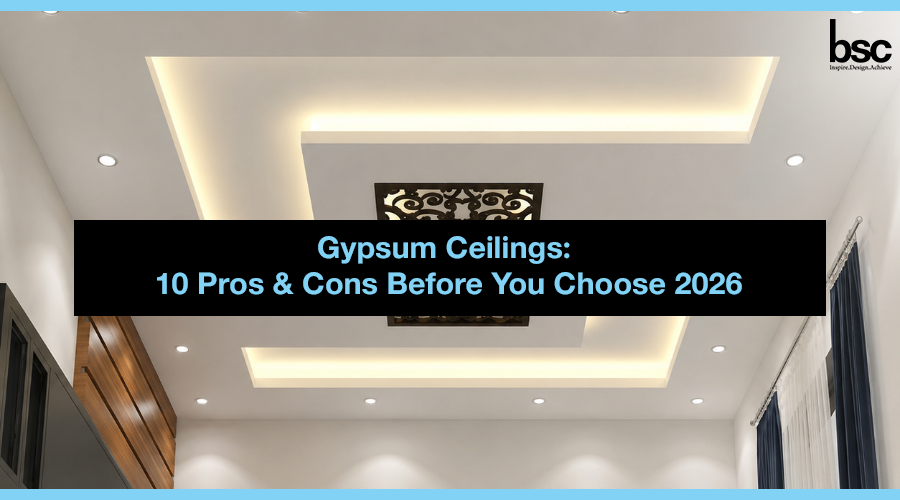
Strip away the marketing language and a gypsum ceiling is simple: it’s a false ceiling made by screwing gypsum plasterboard onto a lightweight metal frame that hangs a few inches (or sometimes a lot more) below the real structural slab.
The board itself is a gypsum core — mostly calcium sulphate dihydrate — sandwiched between two sheets of paper. Once the boards go up on the GI framing, the installer tapes and fills every joint with jointing compound until the whole ceiling reads as one continuous surface instead of a grid of panels stuck together.
For the board itself, we work with Gyproc, our gypsum ceiling channel partner and the brand behind most of the systems we install. That’s a deliberate choice, not just a supplier relationship — Gyproc’s board range covers everything from standard commercial boards to fire-rated, moisture-resistant and flexible curved panels, which means we’re not mixing and matching components from three different manufacturers and hoping they play nicely together.
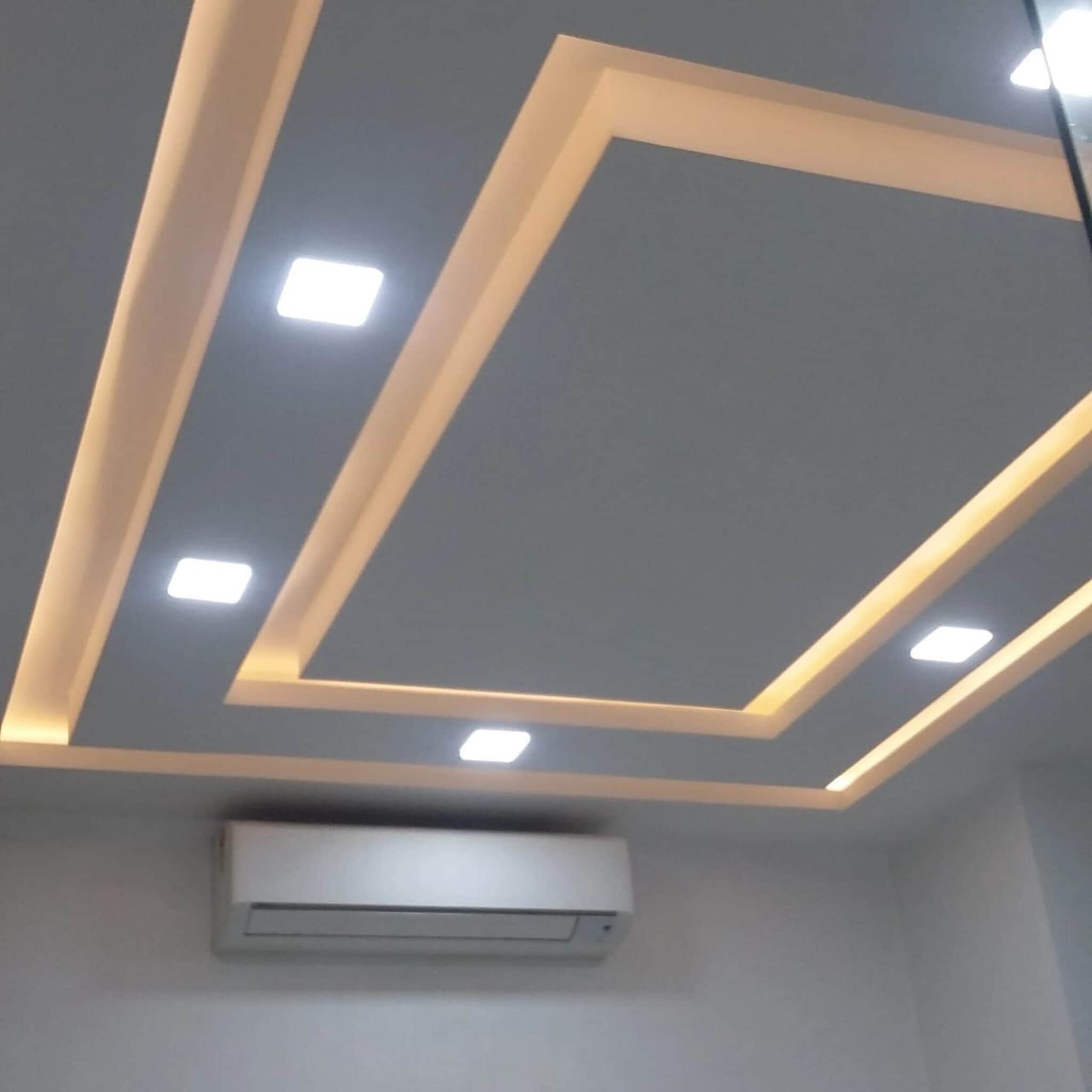
That gap between the real ceiling and the gypsum one is prime real estate. Electrical wiring, AC ductwork, fire sprinklers, recessed lighting, speakers, sensors, insulation, data cabling — pretty much every service a modern building needs gets tucked up there. And because gypsum is workable material, the ceiling built from it doesn’t have to stay flat. It can step, float, curve, or turn into coffered lighting coves, depending on what the designer’s after.
People use these terms interchangeably, which causes more confusion on site than it should.
Feature | Gypsum Board Ceiling | Gypsum Tile Ceiling |
|---|---|---|
Look | Continuous, seamless | Visible grid pattern |
Installation | Boards fixed to hidden framing | Tiles dropped into exposed T-grid |
Service access | Needs dedicated access panels | Individual tiles lift out |
Design flexibility | Great for curves, levels, coves | Better for modular, repeatable layouts |
Repairs | Damaged section cut out and refinished | Swap the tile, done |
Typical use | Lobbies, offices, hotels, retail | Offices, back-of-house, institutional buildings |
Which one you actually want depends less on aesthetics and more on how often someone’s going to need to get back up into that ceiling void. If your building’s MEP systems change often, a board ceiling can become a maintenance headache. If they don’t, board wins on looks almost every time.
It disappears, which is the point. Once the joints are taped, sanded and painted properly, you genuinely can’t see where one board ends and the next starts — exactly what you want in a reception area or boardroom.
It bends to whatever the designer wants. Curved profiles, floating islands, recessed borders, multi-level drops, lighting coves — Gyproc makes flexible panels built for curved work, which is why hospitality and retail brands lean on gypsum so heavily. The ceiling becomes part of the experience, not just a lid on the room.
The fire-resistance claim is real, but overstated. Gypsum board contains chemically bound water that releases as vapour under heat, slowing how fast a fire moves through it. But a single board doesn’t make a ceiling “fire-rated” — that comes from the whole tested assembly. If a project genuinely needs a fire rating, you need Gyproc’s dedicated fire-rated board and a tested system, not a general claim.
It disappears, which is the point. Once the joints are taped, sanded and painted properly, you genuinely can’t see where one board ends and the next starts — exactly what you want in a reception area or boardroom.
It bends to whatever the designer wants. Curved profiles, floating islands, recessed borders, multi-level drops, lighting coves — Gyproc makes flexible panels built for curved work, which is why hospitality and retail brands lean on gypsum so heavily. The ceiling becomes part of the experience, not just a lid on the room.
The fire-resistance claim is real, but overstated. Gypsum board contains chemically bound water that releases as vapour under heat, slowing how fast a fire moves through it. But a single board doesn’t make a ceiling “fire-rated” — that comes from the whole tested assembly. If a project genuinely needs a fire rating, you need Gyproc’s dedicated fire-rated board and a tested system, not a general claim.
It hides the mess. Ductwork, conduit, cabling, plumbing and fire detection all get tucked away — provided someone plans the routing and access points before the boards go up, not after.
It’s faster and drier than wet plaster. Boards arrive at a consistent factory thickness, so you skip the unpredictability of site-mixed material. Jointing still needs proper drying time, but it’s a cleaner build overall.
It’s light on the structure. Gypsum weighs far less than masonry or traditional plaster, easing the load on hangers and the supporting structure — though that’s no excuse to undersize the framing.
Lighting design just works with it. Recessed downlights, cove lighting, linear fixtures — gypsum plays well with nearly any scheme. Just don’t hang anything heavy directly off the board.
Acoustics — with the right system, not any system. There’s a difference between sound isolation (keeping noise from crossing between rooms) and sound absorption (cutting echo within a room), and a plain flat board isn’t great at the second one. Auditoriums and classrooms need perforated acoustic gypsum or added treatment.
It contributes to thermal comfort. A suspended ceiling creates a buffer zone between the room and the slab above, which — combined with the right insulation and HVAC design — helps regulate comfort. Gypsum isn’t insulation on its own, though.
It’s recyclable, when the conditions line up. Gyproc uses recycled paper liners and recycled gypsum content in several board lines, and clean waste can be recovered where a facility exists to process it. Not every demolished ceiling actually gets recycled, so check the documentation rather than assume.

Standard board is not waterproof. Full stop. Regular gypsum has no business near continuous leaks, direct rain, or uncontrolled humidity. Moisture-resistant boards exist, but that’s not the same as waterproof — confirm suitability for the specific application, and fix any existing leaks before the ceiling goes up, not after.
Cracks almost always trace back to installation, not the material. Framing spaced too wide, poor screw fixing, cheap jointing compound, missing tape, skipped control joints — these are workmanship problems, not gypsum problems.
Getting to what’s hidden isn’t easy. A continuous board ceiling doesn’t give you the same access as a drop-tile grid. Something needs attention behind it, and unless access panels were built in from the start, someone’s cutting into finished ceiling and repairing it afterward.
Invisible repairs take real skill. Cutting out the damaged section, backing it, fitting a new board, taping, filling, sanding, priming, repainting — done poorly, you’re left with a visible patch or a slightly different shade of white.
Sagging happens when the system doesn’t match the conditions. Board too thin for the framing spacing, or too much moisture exposure, adds up to sag. Sticking to ceiling-grade Gyproc boards and manufacturer spec cuts this risk significantly, especially in humid climates and heavily air-conditioned buildings.
It’s not great with impact. Gypsum can dent, crack or puncture under a hard enough hit — during maintenance work, lighting swaps, or carelessness above the ceiling. High-traffic or industrial spaces might need something tougher.
Late changes get expensive, fast. Gypsum wants everything — lighting, HVAC, sprinklers, access points — locked in before installation. Change anything after the boards are painted and you’re cutting into finished work and patching visible seams. Get the reflected ceiling plan approved before anyone closes up the ceiling.
Finishing is dusty and multi-step. Hanging boards is fairly clean; cutting, jointing and sanding isn’t. Tape, multiple coats of compound, drying time, sanding, primer, paint — worth remembering in hospitals or any occupied space mid-renovation.
You lose ceiling height. Gypsum eats into clear height depending on duct depth, fixtures and future maintenance clearance. Go too deep in a small room and it starts feeling cramped.
The ceiling is only as strong as its weakest part. Board, GI channels, hangers, screws, tape, insulation, access panels, and — more than anything — the quality of the installer. A great board with cheap framing still gets you a mediocre ceiling. That’s the real argument for comparing whole system specs rather than shopping on board price alone, and for buying through an authorised distributor so every piece in the assembly is genuine.
IF YOU WANT TO GET A DETAILED GUIDE ABOUT DISADVANTAGES OF GYPSUM CEILINGS THEN JUST CLICK HERE…
Lorem ipsum dolor sit amet, consectetur adipiscing elit. Ut elit tellus, luctus nec ullamcorper mattis, pulvinar dapibus leo.
Corporate offices — a clean finish with room to integrate lighting, sprinklers and AC into one coordinated layout. See our office interior solutions.
Retail and showrooms — a clean ceiling keeps attention on the merchandise, not overhead. More in our retail interior solutions.
Hospitals and healthcare — fine for reception and admin areas, though clinical zones usually need specialised hygienic or moisture-resistant products instead. See our healthcare interior solutions.
Schools — works well in classrooms and admin areas, but don’t assume flat gypsum solves acoustics on its own. See our education interior solutions.
Start with the environment — dry office, humid corridor, healthcare space, retail floor. Then list the real performance requirements: fire resistance, sound isolation vs. absorption, humidity resistance, sag resistance, thermal insulation, service access. From there, pick the board type to match — standard, moisture-resistant, fire-rated, impact-resistant, flexible or acoustic.
Check the whole assembly, not just the board: framing gauge, channel spacing, suspension points, fasteners, joint treatment, perimeter detailing. Coordinate services early, before the ceiling closes — lights, diffusers, sprinklers, detectors, access panels. And work from the actual technical documentation rather than marketing copy.
Last thing, and it matters more than people expect on large commercial jobs: buy from a supplier you trust. As an authorised Gyproc distributor, we source every board directly, so what’s on the drawing is what actually goes up on site.