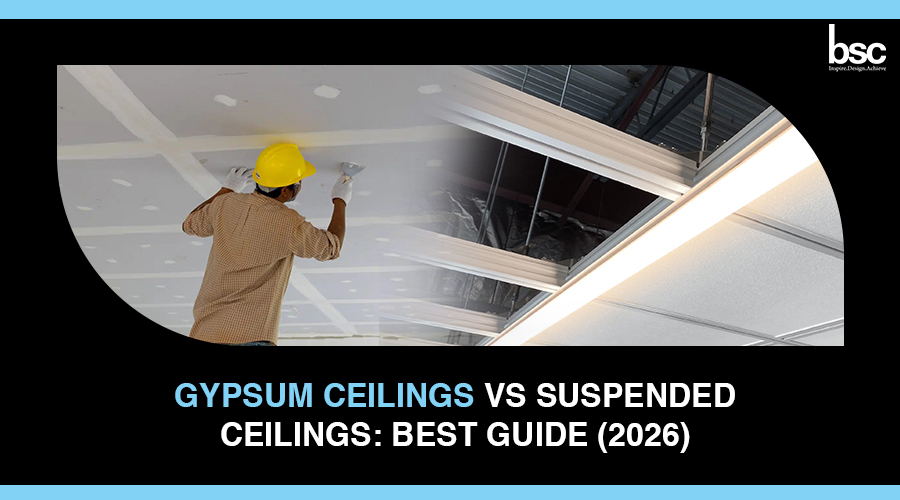
If you’ve ever sat through a ceiling design meeting, you know the moment: someone asks “gypsum or suspended?” and half the room goes quiet. It’s a fair question — both are “false ceilings” in the loosest sense, both hide wiring and ducting overhead, and both show up in almost every commercial fit-out quote you’ll ever receive. But they’re built differently, priced differently, and behave differently over a 10–20 year lifecycle.
This guide breaks down gypsum ceilings vs suspended ceilings in plain terms — what each one is made of, how they compare on fire safety, moisture resistance, acoustics, cost, and maintenance, and which one actually belongs in your project.
What are Gypsum Ceilings?
A gypsum ceiling is built from gypsum boards (plasterboard) — factory-manufactured sheets made from hydrated calcium sulphate sandwiched between paper facings — fixed onto a metal or wooden framework. The joints between boards are filled, taped, and sanded to create a smooth, seamless surface. Once painted, it looks almost indistinguishable from a poured concrete ceiling — no visible grid, no joints, no seams if the finishing is done well.
Gypsum ceilings are popular in spaces where aesthetics matter as much as function: reception areas, boardrooms, retail storefronts, hospital lobbies, and residential interiors. They can be shaped into coves, steps, curves, and recessed lighting pockets — something a grid-based system simply can’t do.
What are Suspended Ceilings?
A suspended ceiling (also called a grid ceiling, drop ceiling, or T-bar ceiling) uses a visible metal grid — usually in a 2×2 ft or 2×4 ft module — suspended from the structural slab above using hanger wires. Ceiling tiles, typically mineral fiber, metal, or gypsum tiles, sit into this grid.
Suspended ceilings are the standard choice for offices, hospitals, schools, and any space where the ceiling needs to come down fast, go back up fast, and give constant access to the plenum above — cabling, HVAC ducts, sprinkler heads, and fire alarms, all of it.
What Are They Made Of?
Element | Gypsum Ceiling | Suspended Ceiling |
Core material | Gypsum board (calcium sulphate core, paper-faced) | Mineral fiber, metal, PVC, or gypsum tiles |
Support structure | GI metal channels or wooden framework | Exposed/semi-exposed metal grid (T-bar/main runner + cross tee) |
Fixing method | Screwed to framework, jointed and taped | Tiles rest in grid, no fixing screws |
Suspension | Rigid, close to slab or dropped for design | Hung on wires, drop height adjustable |
Finish coat | Putty, primer, paint | Factory-finished tile face, no painting needed |
Installation Process & Time
The installation sequence is one of the biggest practical differences between the two systems.
Gypsum ceiling installation typically involves: marking ceiling levels → fixing the metal/wooden framework to the slab → screwing gypsum boards onto the framework → jointing and taping board seams → applying putty and sanding → priming and painting. This is a multi-day, multi-trade process, and the ceiling can’t be considered “finished” until the paint has cured.
Suspended ceiling installation typically involves: marking the level line → fixing wall angles → hanging main runners and cross tees on suspension wires → dropping factory-finished tiles into the grid. There’s no wet work, no drying time, and no painting — the space is usable almost immediately after installation.
Installation Factor | Gypsum Ceiling | Suspended Ceiling |
Typical timeline (mid-size commercial area) | Several days to a few weeks | 1–3 days for the same area |
Wet work involved | Yes (jointing, putty, paint) | No |
Drying/curing time | Required before handover | Not required |
Disruption to site | Higher (dust, paint fumes) | Lower |
Skill level required | Higher — finishing quality is craftsman-dependent | Moderate — largely mechanical fixing |
Cost Comparison
Cost is where most decision-makers get stuck, and the honest answer is: it depends on the specification, not just the category.
Cost Factor | Gypsum Ceiling | Suspended Ceiling |
Material cost | Moderate (board + framework + finishing materials) | Moderate to low (grid + tiles) |
Labour cost | Higher — multiple finishing stages | Lower — modular fixing |
Upfront cost (large open areas) | Generally higher per sq. ft. | Generally lower per sq. ft. |
Repair/replacement cost | Higher — patch, sand, repaint a section | Lower — replace individual tile |
10-year maintenance outlay | Higher | Lower |
Rather than comparing sticker price alone, it’s worth pricing both against your actual project brief — area, access requirements, and design complexity all move the number significantly. In many large projects, the real cost driver isn’t gypsum vs. suspended at all — it’s how much design detailing (coves, steps, cutouts) is specified.
Fire Resistance & Safety
Fire performance depends heavily on the specific product used, not just the ceiling type — but there are general patterns worth knowing.
Suspended ceiling systems can achieve fire-resistance ratings of up to two hours depending on panel composition and grid design, with metal panels and intumescent coatings helping inhibit flame spread. Gypsum board ceilings rely on layered gypsum cores for heat resistance, and while double-layer gypsum systems can match the fire rating of some suspended systems, they tend to be heavier and take longer to install.
Fire Safety Factor | Gypsum Ceiling | Suspended Ceiling |
Typical fire rating | Up to 2 hours with fire-rated (FR) boards, often double-layered | Up to 2 hours with fire-rated tile/grid combinations |
Weight for equivalent rating | Heavier (double-layer boards) | Lighter |
Certification to check | FR board certification from manufacturer | Tile + grid system fire test certification |
Always verify fire ratings against the actual product datasheet rather than assuming a category-wide rating — this varies by manufacturer and board/tile grade.
Moisture & Humidity Resistance
For spaces with fluctuating humidity — kitchens, bathrooms, basements, and pool enclosures — moisture resistance is a critical spec, not an afterthought.
Suspended ceiling panels are often treated to resist sagging and mold growth, with materials like metal offering corrosion-resistant coatings. Standard gypsum board, on the other hand, can absorb moisture and swell unless it’s specifically manufactured as a moisture-resistant (MR) board, which can lead to long-term sagging or staining issues if the wrong grade is used in a humid area.
Moisture Factor | Gypsum Ceiling | Suspended Ceiling |
Standard board/tile behaviour in humidity | Can absorb moisture, may swell or sag | Generally more stable |
Recommended spec for humid areas | Moisture-resistant (MR) gypsum board | Moisture/mold-resistant tiles |
Risk if wrong grade is used | Staining, sagging, mold growth | Lower risk with treated tiles |
Acoustic & Soundproofing Performance
Both systems can be engineered for sound control, but they get there differently. Suspended ceilings with mineral fiber acoustic tiles are purpose-built for sound absorption, which is why they’re the default in open-plan offices, call centers, classrooms, and auditoriums where noise control is a functional requirement, not a nice-to-have.
Gypsum ceilings can also perform well acoustically, but this depends heavily on board thickness, the air cavity above the board, and whether acoustic insulation (like mineral wool) is added within the void — a plain single-layer gypsum board with no insulation won’t do much for noise.
Acoustic Factor | Gypsum Ceiling | Suspended Ceiling |
Out-of-the-box sound absorption | Low unless insulated | High with acoustic-rated tiles |
How performance is achieved | Insulation layer + board thickness | Purpose-built acoustic tile composition |
Best fit for noise-sensitive spaces | Needs specific detailing | Naturally suited (offices, schools, hospitals) |
Aesthetics & Design Flexibility
This is where gypsum has a clear edge. If your architect wants coves, steps, backlit channels, curved bulkheads, or a completely flat, joint-free finish, gypsum is really the only practical option — suspended grids can’t replicate that level of customization. For reception areas and client-facing spaces, the seamless finish reads as more polished and considered, and a well-installed gypsum ceiling can become a genuine design feature with layered sections and integrated lighting.
Suspended ceilings, by contrast, are functional by design. Modern tile finishes have improved considerably and come in a wide range of textures and edge profiles, but the visible grid is, by nature, still a grid — expected and standard in functional spaces like offices and hospitals, rather than seen as a downgrade.
Maintenance & Repairs
Maintenance Factor | Gypsum Ceiling | Suspended Ceiling |
Routine cleaning | Simple — wipe/dust the painted surface | Simple — wipe or vacuum tile surface |
Accessing services above | Requires cutting into the board and patching | Lift the nearest tile, no cutting |
Fixing a stain or damage | Patch, sand, repaint (often the whole panel/section) | Swap the single affected tile |
Repainting cycle | Periodic repainting needed for a fresh look | Not usually required — tiles are factory-finished |
Who typically handles it | Painter/finishing contractor | Facilities/maintenance team, minimal skill needed |
Facilities teams generally prefer suspended ceilings for exactly this reason — any tile can be lifted out in seconds for cabling, HVAC servicing, or fire system checks, with no cutting, patching, or repainting involved. Gypsum ceilings can include access panels for this purpose, but any change outside a planned panel may require cutting and refinishing a section of the ceiling.
Lifespan & Durability
A well-installed gypsum ceiling can last well over a decade, though its painted surface will need periodic refreshing to stay looking new — warranty periods on gypsum ceiling systems commonly run up to around 10 years, with appearance maintained through repainting over time. Suspended ceilings tend to have a longer functional life for the grid itself (often 15–20+ years), since the structural component (the metal grid) rarely needs replacement — only individual tiles wear out and get swapped.
Lifespan Factor | Gypsum Ceiling | Suspended Ceiling |
Structural component lifespan | 10+ years, appearance-dependent | 15–20+ years for the grid |
What wears out first | Paint finish, joints under stress | Individual tiles (staining, sagging) |
Ease of extending lifespan | Repaint/refinish | Replace tiles, grid stays intact |
Weight & Structural Load
Suspended ceiling grids with lightweight tiles generally impose less load on the structural slab than gypsum systems, particularly double-layer fire-rated gypsum boards, which are considerably heavier. This matters more on renovation projects with older slabs or in high-rise buildings where dead-load allowances are tightly calculated — it’s worth checking with your structural consultant before finalizing a heavy double-layer gypsum specification on an existing structure.
Best Applications by Space & Industry
Space / Sector | Better Fit | Why |
Corporate offices (open floor) | Suspended ceiling | Fast install, easy cabling/HVAC access, acoustic tiles |
Reception, boardrooms, lobbies | Gypsum ceiling | Premium, seamless, design-led finish |
Hospitals & healthcare | Suspended (general areas) + Gypsum (specific zones) | Suspended for MEP access; gypsum for cleanroom-style sealed finishes where required |
Educational institutions | Suspended ceiling | Acoustic control, budget-friendly, fast turnaround |
Retail stores | Gypsum ceiling (storefront) + Suspended (back-of-house) | Visual impact upfront, functional access behind the scenes |
Sports facilities & gyms | Suspended ceiling | Large spans, acoustic control, service access |
Residential interiors | Gypsum ceiling | Seamless look, cove lighting, custom detailing |
In practice, most large commercial fit-outs — offices, hospitals, retail chains — use a hybrid approach: suspended ceilings across open work areas and back-of-house zones for speed and access, with gypsum detailing in lobbies, boardrooms, and feature areas for visual impact.
Sustainability & Environmental Considerations
Both systems have a role to play in sustainable interiors when specified correctly. Gypsum board is largely recyclable, and many manufacturers now offer boards with recycled gypsum content. Suspended ceiling grids are typically made from recyclable steel or aluminum, and mineral fiber tiles from several major manufacturers now include recycled content and take-back programs.
If sustainability certification (like LEED or IGBC) is a project requirement, ask your supplier for Environmental Product Declarations (EPDs) and recycled-content data for the exact product line being specified, rather than assuming based on category.
2026 Trends in False Ceiling Design
A few shifts worth knowing about heading into 2026:
- Hybrid ceilings combining gypsum feature zones with suspended grids in the same floor plate continue to grow, especially in commercial fit-outs balancing budget with design impact.
- Integrated lighting — cove lighting in gypsum, and recessed/linear fixtures in suspended grids — is increasingly specified at design stage rather than added later.
- Acoustic performance has become a baseline expectation in offices and schools, not an upgrade, pushing more specifiers toward acoustic-rated tiles even in budget-conscious projects.
- Sustainability documentation (recycled content, EPDs) is increasingly requested by corporate and institutional clients as part of the material approval process.
Pros and Cons at a Glance
Gypsum Ceiling
Pros | Cons |
Seamless, high-end finish | Slower, labour-intensive installation |
Full design flexibility (coves, curves, steps) | Repairs require cutting and repainting |
Good acoustic performance when insulated | Heavier, especially fire-rated double-layer boards |
Long structural life with periodic repainting | Standard boards need MR grade for humid areas |
Suspended Ceiling
Pros | Cons |
Fast, modular installation | Visible grid — less design flexibility |
Instant access to services above | Less suited to curved/custom feature design |
Purpose-built acoustic tile options | Tile edges and grid can look utilitarian if unspecified carefully |
Lower long-term maintenance cost | Grid lines are a fixed visual element |
Which One Should You Choose?
Ask yourself these questions:
- Do I need frequent access to the ceiling void? → Suspended ceiling.
- Is this a design-led, client-facing space? → Gypsum ceiling.
- Is acoustic performance a top priority (open office, classroom)? → Suspended ceiling with acoustic tiles.
- Do I want curves, coves, or a completely flush finish? → Gypsum ceiling.
- Is speed of installation critical? → Suspended ceiling.
- Is the area prone to humidity? → Suspended ceiling, or MR-grade gypsum board specifically.
- Is structural load a constraint (older building, high-rise)? → Suspended ceiling is generally lighter.
Sourcing the Right Materials Matters as Much as the Design Decision
Whichever system you choose, the performance of the ceiling — fire rating, acoustic rating, sag resistance, finish quality — comes down to the board, tile, and grid specification you use, not just the category. This is where working with an authorised distributor rather than an unbranded supplier makes a real difference in long-term performance.
BSC Interiors is an authorised channel partner for some of the industry’s most trusted interior building material brands, including Knauf (gypsum boards and ceiling systems) and Armstrong (suspended ceiling tiles and grid systems), and gyproc alongside Tarkett, Interface, and Steelcase for complete interior fit-outs. Being an authorised distributor means genuine product warranties, verified specifications, and consistent supply — something that matters a great deal on large commercial projects with tight timelines.
Whether you’re speccing gypsum ceilings, suspended ceilings, or a hybrid of both across offices, hospitals, education, retail, or sports facilities, BSC Interiors can help you source the right products from certified brands and get technical guidance on the right system for your space.
Gypsum Ceilings vs Suspended Ceilings: Quick Comparison
Factor | Gypsum Ceiling | Suspended Ceiling |
Finish | Seamless, monolithic | Visible grid lines |
Design flexibility | High — curves, coves, steps | Limited to flat tile modules |
Access to services | Requires cutting/patching | Tiles lift out instantly |
Installation speed | Slower, more labour-intensive | Faster, modular |
Maintenance | Repainting/patching needed | Swap individual tiles |
Acoustic performance | Good with insulation layer | Excellent with acoustic tiles |
Typical use case | Lobbies, retail, homes, boardrooms | Offices, hospitals, schools, labs |
Long-term upkeep cost | Higher if damaged | Lower — tile-level replacement |
Frequently Asked Questions (FAQs)
Which is cheaper — gypsum ceiling or suspended ceiling?
For a large open floor, suspended ceilings usually win on price. The grid goes up fast and there’s no painter on-site for three extra days. Gypsum costs more to begin with, but you’re paying for the finish and the design freedom that comes with it — so it’s less about “cheaper” and more about what you actually need the ceiling to do.
Which ceiling type is better for offices?
In most offices we’ve seen, it isn’t really a choice between the two — it’s both. Suspended tiles cover the desks and open floor because IT and facilities need to get in there constantly, while gypsum shows up in the lobby or the boardroom where first impressions matter more than easy access.
Do suspended ceilings look cheap compared to gypsum?
That reputation is a bit outdated. Tile finishes have come a long way, and in a functional space — an office, a hospital corridor — a grid ceiling is simply what people expect to see. Nobody walks into a clinic and feels short-changed by a suspended ceiling.
Can gypsum ceilings and suspended ceilings be combined in one project?
All the time, actually. It’s probably the most common approach on bigger jobs — gypsum where the design needs to shine, suspended everywhere the budget and the maintenance team need it to behave.
Which ceiling offers better fire safety?
Honestly, this one comes down to the exact product, not the category. Both gypsum boards and suspended tile-and-grid systems can be specified with fire ratings up to two hours. Don’t take a salesperson’s word for it either way — ask for the fire test certificate on the specific board or tile you’re buying.
Which is better for humid areas like kitchens or bathrooms?
Suspended tiles tend to shrug off humidity a little more easily out of the box. If you’re set on gypsum for the look, just make sure it’s moisture-resistant (MR) board — a standard board in a steamy bathroom is asking for trouble down the line.
How long does each ceiling type last?
Gypsum ceilings are typically rated for around a decade, and honestly, the paint will start asking for attention before the board itself does. Suspended grids tend to outlast that by a good margin — 15 to 20 years isn’t unusual — because the metal structure barely wears; you’re just swapping the odd tile here and there.
Is a suspended ceiling heavier or lighter than a gypsum ceiling?
Lighter, in most cases — and it adds up. This matters more than people expect on older buildings or upper floors, where a heavy double-layer fire-rated gypsum ceiling can push against what the slab was designed to carry. Worth a quick check with your structural engineer before locking in the spec.
Conclusion
There’s no single “better” answer here — it genuinely depends on what a space needs to do. A hospital corridor and a hotel lobby aren’t solving for the same problem, and the ceiling above each one shouldn’t be either.
If you’re chasing a clean, custom, high-end look and can afford a slightly longer install, gypsum earns its keep. If you need a ceiling that goes up fast, comes apart just as easily for the technician who has to fix the AC six months later, and handles noise well in a busy room, suspended is the more practical call. And on most real projects, the smartest answer is a bit of both — gypsum where people are meant to notice it, suspended where people are meant to work under it.
The one thing that matters regardless of which way you go: source it properly. A fire rating or an acoustic spec is only real if the product behind it is genuine.
Ready to spec your ceiling? Get in touch with BSC Interiors — we’re an authorised distributor for Knauf gypsum systems and Armstrong suspended ceiling solutions, along with Tarkett, Interface, and Steelcase, and we work across office, healthcare, education, retail, and sports projects throughout India. Tell us the space and we’ll help you land on the right system, not just the cheaper one.