
Skip to content

Interior Building Materials Supplier in Bangalore – 2026

Interior Building Materials Supplier in Bangalore - 2026

Finding the right interior building materials supplier in Bangalore isn’t just another line item on a project checklist — it’s usually one of the things that quietly determines whether a commercial fit-out finishes on time or drags into extra weeks of back-and-forth. Corporate offices, IT parks, hospitals, schools, retail stores, hotels — each of these spaces asks something different of its materials. What holds up in a busy hospital corridor isn’t what you’d pick for a boutique retail floor, and a hotel lobby has its own set of demands entirely.

Things get more complicated the moment a project needs more than one category of material. Ceilings might come from one spec, flooring from another, furniture from a completely different schedule, and sanitaryware from yet another vendor altogether. Handled separately, that’s a lot of coordination, a lot of quotations to chase, and a lot of approvals sitting in different inboxes.

That’s usually where an experienced interior building materials supplier in Bangalore earns their keep — not by selling more, but by taking some of that coordination off your plate.

For architects, interior designers, contractors, builders, consultants, and procurement teams, the real goal was never just “buy materials.” It’s identifying the right products, comparing what’s actually available, understanding the technical fine print, planning quantities properly, getting samples approved without delay, and making sure everything shows up on site when it’s supposed to.

What Does an Interior Building Materials Supplier Actually Do?

Interior Building Materials Distributor in Bangalore - 2026

At the most basic level, a supplier like this provides the products that go into commercial interior spaces — across a fairly wide range of categories and applications.

Depending on who you’re working with, that portfolio can stretch across ceiling systems, flooring, wall and surface finishes, workspace furniture, sanitaryware, plumbing fittings, lighting, plywood, laminates, and other architectural finishing materials.

But for a commercial project, the job rarely stops at “here’s your order.” A good supplier ends up helping a project team figure out which product categories actually fit the brief, checking what’s realistically available, arranging samples, putting together quotations, sorting documentation, and planning deliveries around the project’s actual schedule — not some generic timeline.

So when you’re evaluating a commercial interior building materials supplier in Bangalore, the number of products in their catalogue matters less than you’d think. What matters more is whether they actually understand what your project needs and can coordinate procurement around it.
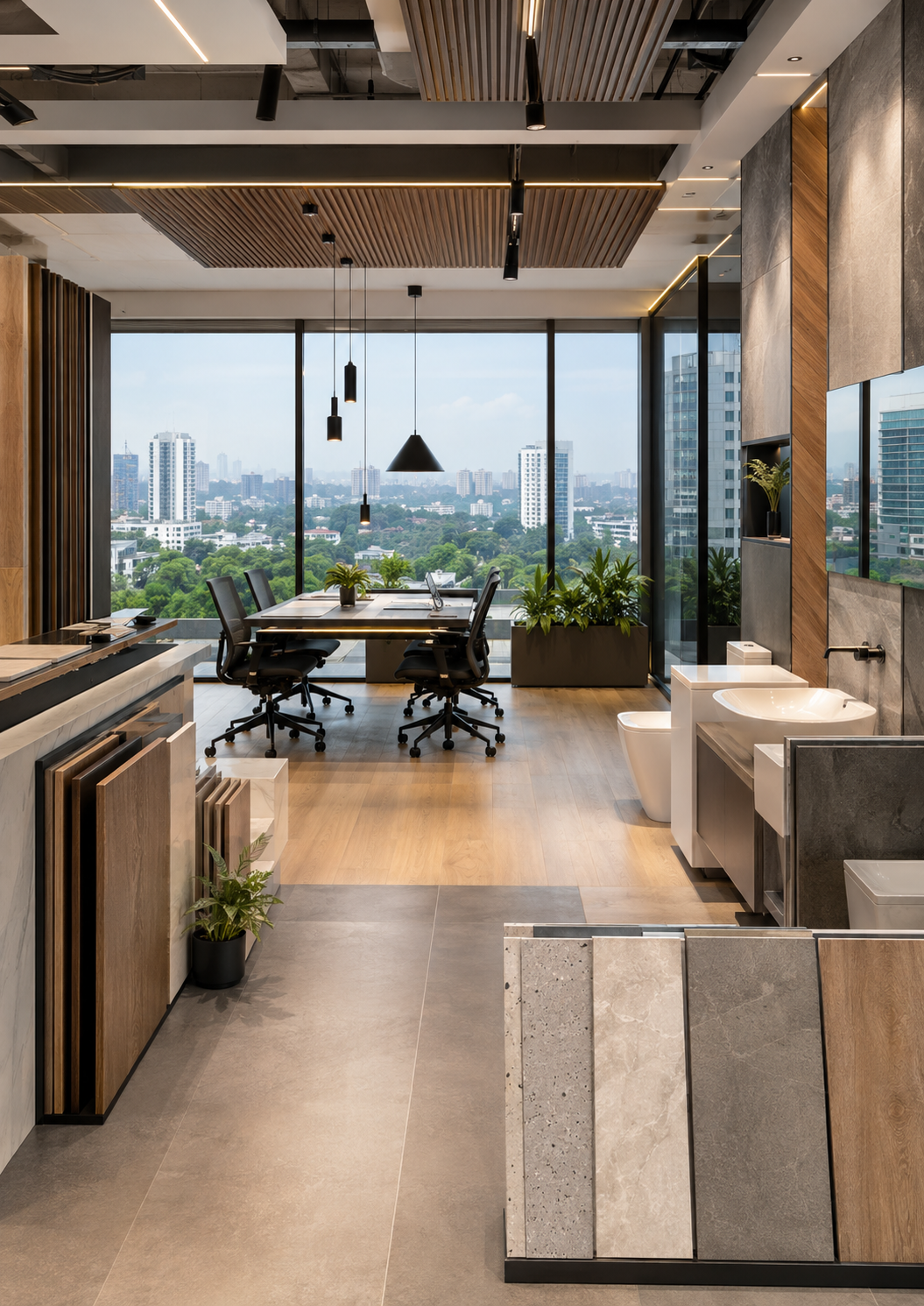
Why Commercial Projects Need a Supplier They Can Actually Rely On

Commercial interiors tend to involve big quantities, several material categories running in parallel, and handover dates that don’t move just because a shipment is late.

A delay in one material can hold up several activities that were waiting on it. Pick the wrong product, and you’re looking at replacement costs, stalled approvals, or maintenance headaches that show up months later. A supplier who’s actually good at this brings some structure to what would otherwise be a fairly chaotic process.

One Relationship Instead of Five

A single commercial project can need ceiling materials, flooring, wall finishes, furniture, sanitaryware, lighting, plywood, and laminates — often at different stages of the build. Working with a supplier who covers most or all of that means fewer separate vendor relationships for your procurement team to keep track of, fewer invoices to reconcile, and fewer people to call when something’s not adding up.

Actually Helping You Narrow Down Options

Commercial projects usually work off approved specs and product schedules. Before anything gets finalized, someone has to compare finishes, dimensions, technical data, availability, and cost across a handful of options. A supplier who actually knows their categories can point you toward what’s relevant instead of handing over a catalogue and letting you figure it out yourself.

Getting Samples Right the First Time

Samples matter more than people sometimes admit, especially where colour, texture, or finish needs sign-off from an architect, designer, or client. Getting this right before bulk procurement saves you from the far more expensive problem of ordering a full batch that doesn’t actually match what everyone agreed on.

Handling Bulk and Phased Delivery Without Drama

Big projects almost never come down to one delivery truck showing up once. Materials usually need to land at different sites, or in different phases, at specific points in the schedule. That means quantity planning, stock checks, honest conversations about lead times, and delivery coordination all become part of the job — not an afterthought.

The Major Material Categories Commercial Projects Actually Need

Interior Building Materials Distributor in Bangalore - 2026

What’s “right” depends entirely on the project — its use, its design intent, and what it needs to hold up against day to day.

Ceiling Solutions

Ceilings do more work than people give them credit for — appearance, acoustics, and how lighting integrates into the space, on top of basic function. Depending on the application, that could mean mineral fibre ceilings, acoustic ceilings, metal ceiling systems, gypsum ceilings, calcium silicate boards, or other suspended systems.

In occupied corporate spaces, acoustic performance tends to matter a lot — nobody wants a meeting room where every word carries three cubicles over. In areas exposed to moisture or specific environmental conditions, durability and moisture resistance move up the priority list instead. A ceiling material supplier in Bangalore who’s actually done this before can help narrow the field based on what the space genuinely needs, rather than what looks good in a brochure.

Commercial Flooring

Flooring probably takes more day-to-day abuse than any other interior surface in a commercial building. What works depends on foot traffic, how often it gets cleaned, acoustic expectations, and simply what the space is used for.

Common options include vinyl flooring, homogeneous vinyl, carpet tiles, SPC flooring, commercial carpets, and other resilient flooring types. Carpet tiles tend to suit office environments where design flexibility and acoustic comfort matter. Vinyl flooring usually wins out where easy maintenance and durability are the priority — hospital corridors, for instance. Flooring choices should really come from what the space actually demands, not just what photographs well.

Wall and Surface Solutions

Walls are where aesthetics and performance have to meet somewhere in the middle. Commercial projects lean on wall panels, decorative surfaces, glass films, and other finishes depending on the design brief and how much wear the wall needs to survive. A wall solution supplier in Bangalore worth working with will help weigh finish against durability against maintenance, rather than just pushing whatever’s in stock.

Workspace Furniture

Furniture shapes how a workplace actually feels to use — which matters more in corporate environments than almost anywhere else. Office fit-outs typically need workstations, ergonomic seating, meeting tables, executive furniture, storage, and collaborative pieces.

Good furniture selection weighs ergonomics, how space actually gets used, employee comfort, durability, layout flexibility, and design consistency across floors. For a large workplace project, coordinating furniture procurement alongside the rest of the interior programme keeps everything looking like it belongs to the same building, instead of five different projects stitched together.

Sanitaryware and Plumbing

Commercial washrooms take a beating that residential bathrooms never see. Depending on the project, that means sanitaryware, faucets, plumbing fittings, concealed systems, and other washroom essentials — chosen with usage patterns, hygiene, maintenance, and water efficiency in mind. Offices, hospitals, hotels, and schools all put very different demands on the same basic fixtures, so a sanitaryware supplier in Bangalore needs to actually understand the difference.

Lighting

Lighting is one of those categories that’s easy to underrate until it’s wrong. It does real functional work and real design work at the same time. Offices, retail stores, hotels, hospitals, and schools all need something different from their lighting setup, and procurement usually spans architectural lighting alongside standard office lighting. It’s worth coordinating lighting choices with ceiling layout early — retrofitting it later is rarely painless.

Plywood and Laminates

Plywood and laminates show up everywhere — furniture, cabinetry, wall panels, partitions. What matters here is application, durability, finish, thickness, and how consistent the material stays across large quantities. Consistency becomes a bigger deal than people expect once you’re ordering enough to cover multiple floors or multiple sites.
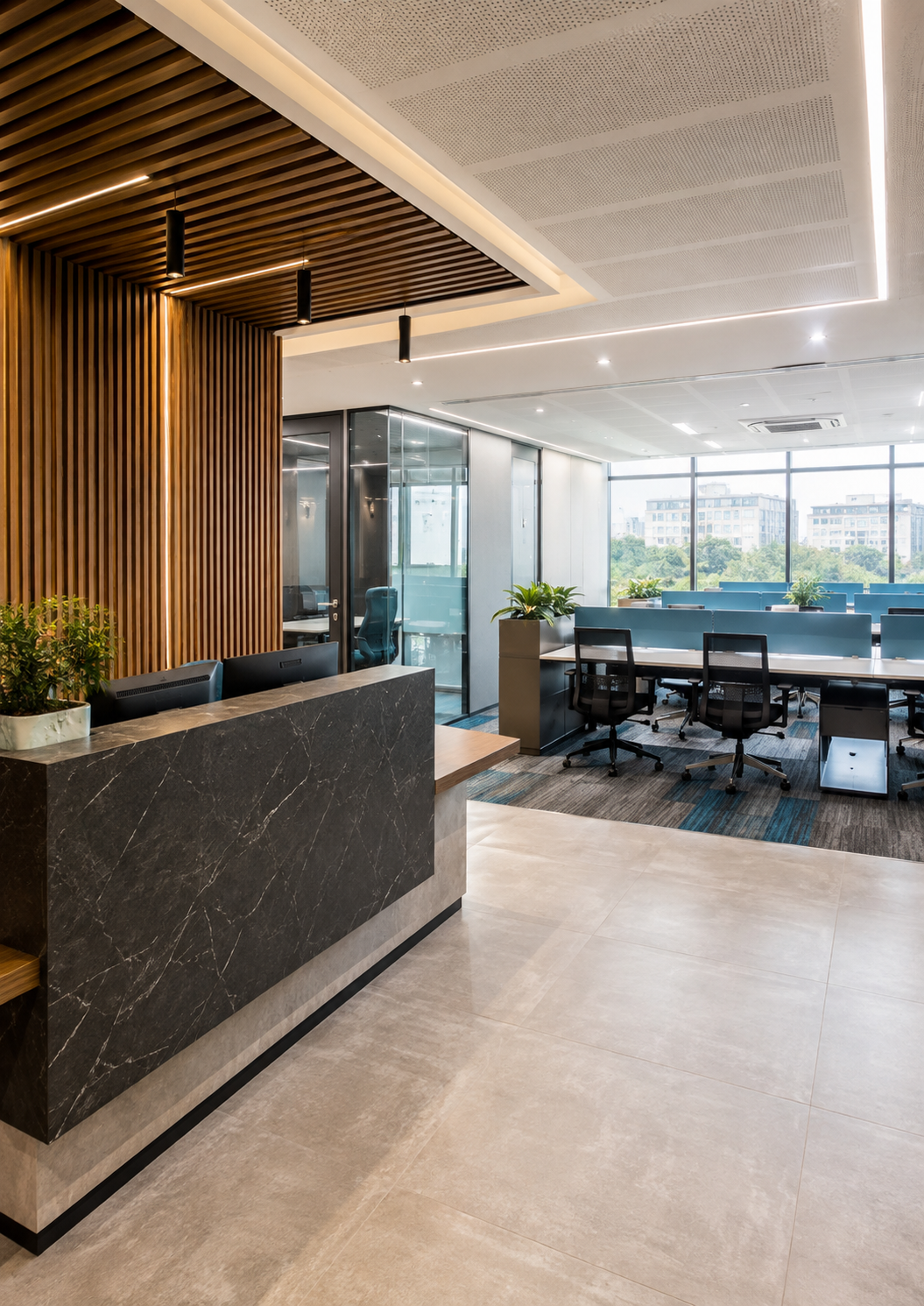
Material Requirements Change by Sector — There's No One-Size-Fits-All

No single material combination works across every kind of commercial building, because no two sectors use their spaces the same way.

Corporate offices usually need a mix of acoustic ceilings, commercial flooring, workspace furniture, wall finishes, lighting, and washroom solutions — with employee comfort, acoustics, and flexibility near the top of the list.

Hospitals have specialised needs that don’t leave much room for compromise — hygiene, resistance to constant cleaning, and durability tend to outweigh appearance. A product’s suitability here should be judged by how it performs under healthcare-specific conditions, not by how it looks in a showroom.

Educational institutions deal with heavy daily wear from students moving through constantly, so flooring, wall finishes, ceilings, and furniture all need to hold up to that — with safety and comfort factored in too.

Retail spaces are a balancing act between looking good and surviving high footfall, frequent cleaning, and the occasional display change that involves dragging fixtures across the floor.

How to Actually Choose an Interior Building Materials Supplier in Bangalore

The lowest quote is rarely the whole story. It’s worth judging a supplier against the entire procurement process, not just the number at the bottom of the page.

Check what they actually cover. If your project spans multiple categories, a supplier with a broader portfolio tends to simplify both procurement and communication considerably.

Look into their brand and manufacturer relationships. These relationships shape product availability and access to real product information — but always confirm current distribution or channel status for a specific brand before it gets locked into a spec. Status can and does change.

Ask for the actual technical documentation. Depending on the category, that could mean datasheets, certifications, performance data, installation requirements, or sustainability documentation. Don’t settle for a brochure when you need a data sheet.

Get real clarity on availability and lead times. A product can tick every box on the spec sheet and still cause problems if it simply can’t arrive when the project needs it. Have this conversation before the material gets finalized, not after.

Think about quantity from the start. Bulk commercial procurement is a different conversation from buying for a small space. Ask directly about quantity availability, commercial terms, dispatch planning, and how phased delivery would actually work.

Pay attention to how they handle enquiries. A supplier worth working with should be able to understand your requirement, identify the right category, work out quantity and timeline, prepare a quotation, arrange samples, finalize the material, and coordinate dispatch — without you having to chase every step.

How BSC Interiors Supports Commercial Procurement in Bangalore

BSC Interiors Pvt Ltd runs its Bangalore branch as an interior building materials distributor, supporting commercial and institutional projects across the city. The Bangalore operation covers ceilings, flooring, wall and surface solutions, workspace furniture, sanitaryware and plumbing fittings, lighting, plywood, and laminates.

The focus here is material supply, not interior design execution — that distinction matters, because it shapes what you should expect from the relationship. A project team can approach BSC with a BOQ line item, a floor plan, a rough material requirement, or even just a basic project scope, and the procurement conversation starts from there.

The process generally runs through understanding the requirement, narrowing the category, working out quantity and timeline, preparing a commercial quotation, arranging samples where needed, finalizing the material, and coordinating dispatch. It’s a structure that tends to work particularly well when a project has several specs and material categories that all need to move together.

BSC’s Bangalore page also covers sector-specific work across education, sports, retail, hospital, and corporate projects.

Brands and Product Categories

BSC’s Bangalore operation carries a mix of national and international brands across its categories — names like Knauf, Gyproc, Everest, Hilux, Rockwool, Steelcase, Interface, Tarkett, 3M, Kohler, Hindware, Geberit, Roca, Grohe, American Standard, Schell, Havells, Wipro, Greenlam, Greenply, and others.

Since availability and brand partnerships can shift depending on specification, quantity, and location, it’s worth confirming current stock and partnership status before any specific brand gets locked into a BOQ.

What to Send a Material Supplier to Get a Useful Response Back

Interior Building Materials Distributor in Punjab - 2026

The clearer the requirement, the faster and more relevant the response you’ll get. It generally helps to share:

  • Project type — corporate office, hospital, retail, hospitality, education, IT park, and so on
  • Project location — the exact site location within Bangalore
  • Material category — flooring, ceiling, wall solution, furniture, sanitaryware, lighting, plywood, laminates, or whatever else applies
  • Specification — preferred brand, product, size, finish, or technical requirement, if you already have one
  • Quantity — even an approximate figure or BOQ quantity helps
  • Timeline — when material needs to be on site, or which project phase it’s for
  • Drawings or BOQ — where available, these cut down on guesswork considerably

Sharing this upfront tends to save a fair amount of back-and-forth later.

Frequently Asked Questions

Who counts as an interior building materials supplier in Bangalore?

Someone who provides the materials used in commercial interior projects — ceilings, flooring, wall solutions, furniture, sanitaryware, lighting, plywood, and laminates being the usual categories.

What materials do commercial interiors typically need?

Ceiling systems, commercial flooring, wall and surface solutions, workspace furniture, sanitaryware, lighting, plywood, and laminates cover most of it.

Can suppliers actually handle bulk requirements?

Generally, yes — though it depends on product availability, order size, project timeline, and the supplier’s own distribution capability. Worth confirming rather than assuming.

Do architects and contractors buy directly from suppliers?

Yes, regularly. Architects, contractors, interior designers, builders, consultants, and procurement teams all approach suppliers directly with specs, BOQs, quantities, and timelines.

How should I actually go about selecting a supplier for a commercial project?

Look at their product range, manufacturer relationships, technical knowledge, documentation, lead times, commercial terms, and whether they can genuinely support phased or project-based delivery — not just their price sheet.

Can one supplier cover multiple material categories?

Some can, and when they do, it usually makes coordinating a multi-category project a lot easier than juggling separate vendors for each one.

Is the cheapest material always the right call?

Not really. Technical suitability, durability, maintenance needs, availability, and how the material holds up over its lifecycle all matter more than the sticker price alone.

Final Thoughts

Choosing an interior building materials supplier in Bangalore isn’t a decision to rush through. The right one understands what your project actually needs, offers relevant options instead of a generic catalogue, supports the technical and sample side of things properly, is upfront about availability and lead times, and coordinates supply around your actual schedule — not a best-case scenario.

For architects, designers, contractors, builders, and procurement teams juggling ceilings, flooring, wall finishes, furniture, sanitaryware, lighting, and more, a supplier who can genuinely cover multiple categories tends to make the whole process noticeably less painful.

In the end, it was never really about sourcing more material. It’s about sourcing the right material, in the right quantity, to the right spec, on the right timeline.

For commercial projects in Bangalore, project teams can share their BOQ, specifications, or material requirements with BSC Interiors to work through suitable options and project-based supply.