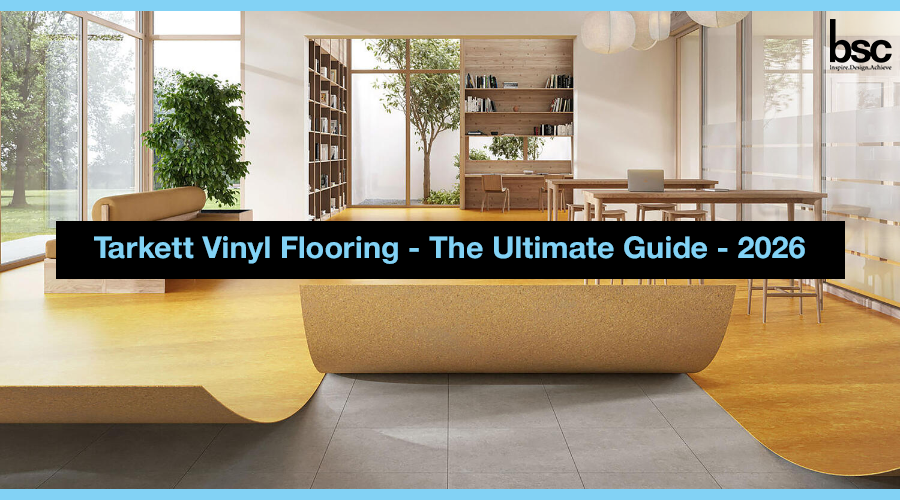
If you’ve been researching flooring options for a corporate office, hospital, school, retail store, or even your home, chances are Tarkett’s name has come up more than once. Tarkett is one of the world’s leading manufacturers of resilient flooring, and its vinyl range — from homogeneous sheet to heterogeneous vinyl f — has become the go-to specification for architects and facility managers across India.
This guide breaks down everything you need to know about Tarkett vinyl flooring in 2026: the different product types, real-world benefits, where each type works best, how installation actually happens, and how to buy the right product from a trusted source.
What Is Tarkett Vinyl Flooring?
Tarkett is a global flooring manufacturer with operations in more than 100 countries, and vinyl is at the core of its commercial and residential portfolio. Tarkett vinyl flooring is built by fusing multiple layers of PVC-based material into a single, highly engineered product — designed to handle heavy foot traffic, resist stains and moisture, and hold its appearance for years without demanding constant upkeep.
Unlike generic vinyl, Tarkett’s flooring lines are developed with specific end-uses in mind — hospitals that need infection control, schools that need durability under constant impact, offices that need acoustic comfort, and retail spaces that need design flexibility. This purpose-built approach is a big part of why Tarkett has become a preferred specification among architects and interior consultants.
Tarkett flooring is also positioned around sustainability: its vinyl products are formulated to be phthalate-free, carry low VOC emissions, and in several ranges are engineered for closed-loop recycling — a factor that increasingly matters for LEED and IGBC-rated green building projects in India.
Types of Tarkett Vinyl Flooring
Broadly, Tarkett’s vinyl portfolio splits into a few core categories:
- Homogeneous Vinyl Flooring — single-layer, through-pattern construction
- Heterogeneous Vinyl Flooring — multi-layer construction with a printed design layer
- Vinyl Rolls — large-format sheet flooring for seamless, hygienic installations
For commercial and institutional projects in India — offices, hospitals, schools, retail — the two categories that come up most often are homogeneous and heterogeneous vinyl. Let’s look at each in detail.
Tarkett Homogeneous Vinyl Flooring
Homogeneous vinyl flooring is composed of a single, uniform layer of vinyl compound, glued down to the sub-floor and heat-welded at the seams for a completely sealed, hygienic surface. Because the color and pattern run all the way through the material — not just printed on top — the design doesn’t wear away even under years of heavy foot traffic.
Where it excels:
- Hospitals, clinics, and diagnostic centers (infection control is critical)
- Schools and colleges (very heavy daily traffic)
- Laboratories and industrial/clean environments
Why specifiers choose it:
Tarkett’s homogeneous ranges are engineered so the surface can be dry-buffed to restore its finish, rather than requiring repeated chemical stripping and re-waxing. This can meaningfully cut down on maintenance costs over the life of the floor and reduces the chemical load in sensitive environments like hospitals — a genuine advantage for facility teams managing large healthcare or education campuses.
Tarkett Heterogeneous Vinyl Flooring
Heterogeneous vinyl flooring is built from multiple bonded layers — typically a wear layer, a printed design layer, and a backing/cushioning layer. Because the pattern is printed rather than running through the whole thickness, heterogeneous vinyl opens up far more design possibilities: wood looks, stone looks, abstract patterns, and bold colorways that would be difficult to achieve with a homogeneous construction.
Where it excels:
- Corporate offices and co-working spaces
- Hospitality — hotel corridors, lobbies, banquet areas
- Retail stores and showrooms
- Areas needing rolling-load resistance (trolleys, wheelchairs, equipment carts)
Why specifiers choose it:
Beyond design freedom, heterogeneous vinyl is engineered for heavy traffic and rolling loads, and many ranges carry certifications for being easy to clean and asthma/allergy friendly — an important consideration for workplaces and healthcare-adjacent facilities where indoor air quality matters.
Key Benefits of Tarkett Vinyl Floor
- Durability under heavy use Both homogeneous and heterogeneous constructions are built for continuous foot and rolling traffic — a core requirement in hospitals, schools, and commercial buildings that see thousands of footfalls a day.
- Hygiene and infection control Heat-welded seams create a continuous, joint-free surface with no gaps for bacteria, moisture, or dust to collect — a major reason vinyl is the default flooring choice in Indian hospitals and diagnostic labs.
- Design flexibility From realistic wood and stone visuals to bold abstract patterns, Tarkett’s design catalog lets architects match flooring to brand identity or interior concept without sacrificing performance.
- Acoustic and underfoot comfort Cushioned backings in several ranges reduce impact noise and add comfort — valuable in offices, schools, and hospitality settings where noise control matters.
- Lower lifecycle maintenance cost Dry-buff-friendly homogeneous ranges reduce the need for chemical stripping and re-waxing, which lowers both maintenance cost and chemical exposure over the floor’s lifetime.
- Sustainability credentials Phthalate-free formulations, low VOC emissions, and recyclability make Tarkett vinyl a strong fit for LEED/IGBC-certified green buildings — increasingly a requirement for large Indian corporate and institutional projects.
- Cost-effectiveness versus other hard surfaces Compared to natural stone, hardwood, or high-end tile, vinyl delivers a comparable premium look at a lower material and installation cost, with far less long-term maintenance burden.
Applications: Where Tarkett Commercial Flooring Fits Best
| Sector | Recommended Type | Why |
| Hospitals & Healthcare | Homogeneous vinyl | Infection control, seamless welded joints, chemical resistance |
| Schools & Colleges | Homogeneous vinyl | Extreme durability, low lifecycle maintenance |
| Corporate Offices | Heterogeneous vinyl | Design variety, acoustic comfort, brand-aligned aesthetics |
| Retail & Showrooms | Heterogeneous vinyl | Visual impact, quick installation, easy replacement |
| Hospitality (Hotels) | Heterogeneous vinyl | Rolling-load resistance, premium wood/stone visuals |
| Sports Facilities | Specialized sports vinyl | Shock absorption, slip resistance |
| Industrial & Labs | Homogeneous / static-control vinyl | Chemical resistance, static-control options |
This is exactly the range of sectors BSC Interiors serves across Delhi NCR and pan-India — office fit-outs, hospitals, education campuses, retail chains, and sports facilities all draw on different points in the Tarkett vinyl range.
Entire Installation Process of Vinyl Flooring
While installation should always be handled by trained professionals, here’s what the process typically looks like for Tarkett vinyl flooring:
- Sub-floor preparation — The existing floor is cleaned, leveled, and checked for moisture content. This step is critical; a poorly prepped sub-floor is the leading cause of premature vinyl flooring failure.
- Acclimatization — Vinyl rolls or tiles are allowed to adjust to the site’s temperature and humidity before laying, to prevent expansion/contraction issues later.
- Adhesive application — A suitable adhesive is applied based on the product type and sub-floor condition.
- Laying the flooring — Sheets or tiles are laid according to the design plan, with careful attention to seam alignment.
- Heat welding (for sheet vinyl) — Seams are heat-welded using matching welding rods, creating a monolithic, joint-free surface — essential for hospitals and labs.
- Finishing and quality check — Edges are trimmed, skirtings/accessories are fitted, and the installed floor is inspected for surface defects before handover.
A professional installer familiar with Tarkett’s specified adhesives, welding rods, and underlayment accessories makes a measurable difference to how the floor performs over 10-15+ years — which is why sourcing through an authorized distributor with in-house installation expertise (rather than a generic contractor) is strongly recommended for large commercial projects.
Maintenance & Lifespan
Tarkett vinyl flooring, when installed and maintained correctly, is designed to perform well for 15-20+ years in commercial settings. Routine maintenance is straightforward:
- Daily dust mopping or vacuuming to remove grit
- Damp mopping with a pH-neutral cleaner
- Periodic dry-buffing (for homogeneous ranges) to restore shine without chemical stripping
- Prompt cleanup of spills to avoid slip hazards
- Use of walk-off mats at entrances to reduce grit transfer
Facility teams that follow a structured maintenance schedule typically see a meaningfully longer service life and lower total cost of ownership compared to reactive, as-needed cleaning.
Tarkett Flooring India: Availability & Market Presence
Vinyl flooring adoption in India has accelerated sharply over the past few years. As office fit-outs, hospital construction, retail chains, and educational infrastructure have scaled up, SPC, and commercial-grade sheet vinyl have become the preferred alternative to marble, ceramic tile, and laminate — largely because of vinyl’s combination of performance, ease of maintenance, and faster installation timelines.
Tarkett has built a strong footprint in this market through its network of authorized Indian distributors, who provide not just product supply but also technical specification support, sampling, and installation services for architects, contractors, and facility managers across major metros.
Buying Guide: How to Choose the Right Tarkett Vinyl Flooring Supplier
Not every vinyl flooring seller in India carries genuine Tarkett product or the technical expertise to install it correctly. When evaluating a Tarkett Vinyl Flooring Supplier, look for:
- Authorized distributor status — Confirms genuine product, valid warranty, and manufacturer-backed technical support.
- Sector-specific experience — A supplier who has executed hospital, education, and corporate projects will understand code compliance and design nuances specific to each.
- In-house or vetted installation teams — Installation quality directly affects seam integrity, durability, and warranty validity.
- Sample and specification support — Ability to provide physical samples, technical datasheets, and CAD/BOQ support for architects and consultants.
- After-sales and maintenance guidance — Ongoing support for AMC, dry-buffing schedules, and replacement parts.
- Pan-India project delivery capability — Especially important for multi-location corporate or retail rollouts.
Why BSC Interiors Is Among India's Leading Tarkett Vinyl Flooring Suppliers
If you’re sourcing Tarkett vinyl flooring in India, BSC Interiors is one of the country’s leading authorized Tarkett distributors, serving clients across Delhi NCR and pan-India metropolitan markets.
What sets BSC Interiors apart:
Authorized Tarkett distribution — Genuine, warranty-backed Tarkett homogeneous, heterogeneous, and product lines, sourced directly rather than through the grey market.
Multi-sector project experience — BSC Interiors has supplied and installed Tarkett flooring across office fit-outs, healthcare facilities, educational institutions, retail chains, and sports infrastructure — alongside other globally recognized brands like Knauf, Armstrong, and Steelcase.
End-to-end service — From product specification and sampling through to professional installation and after-sales support, BSC Interiors manages the full project lifecycle rather than just supplying material.
Delhi/Okhla-based operations with pan-India reach — Centrally positioned logistics for faster turnaround on both metro and multi-city rollouts.
Architect and consultant relationships — A track record of working directly with design and build teams to translate specification drawings into finished, code-compliant flooring installations.
For architects, facility managers, and businesses evaluating Tarkett vinyl flooring for their next project, working with an established, authorized distributor like BSC Interiors reduces risk — you get genuine product, correct installation, and a single point of accountability from specification to handover.
Conclusion
Tarkett vinyl flooring has earned its place as one of the most specified resilient flooring solutions in India — and for good reason. Whether it’s homogeneous vinyl bringing infection control and dry-buff durability to a hospital, or heterogeneous vinyl and giving a corporate office the design flexibility to match its brand, Tarkett’s range covers nearly every commercial and institutional use case without compromising on performance or lifecycle cost.
The bigger decision, though, often isn’t which Tarkett range to choose — it’s who you buy and install it through. Genuine product, correct sub-floor prep, proper heat-welding, and manufacturer-backed warranty support all depend on working with an authorized distributor rather than a reseller cutting corners. That’s where a partner like BSC Interiors makes the difference: pairing genuine Tarkett product with the sector experience and installation expertise needed to get a 15-20 year floor right the first time.
If you’re specifying or purchasing Tarkett vinyl flooring for an upcoming project, use this guide as your reference point — and loop in an authorized supplier early, while the project is still in the specification stage, to avoid costly changes later.