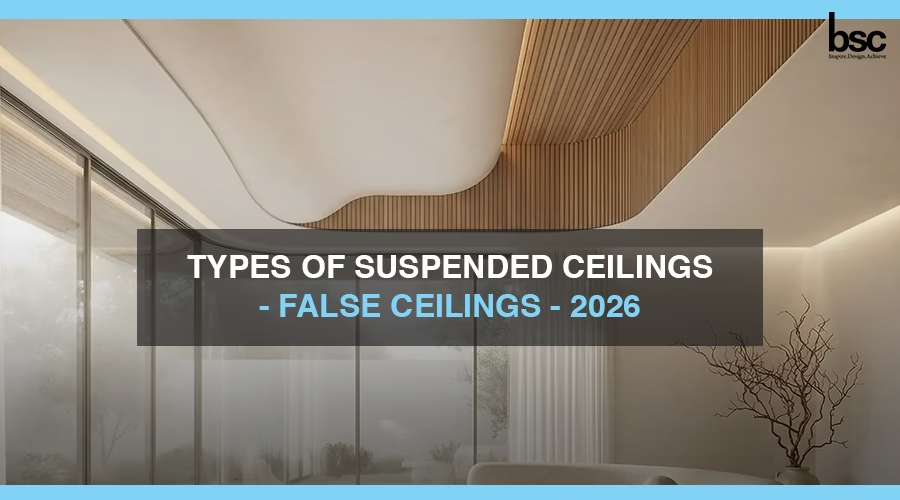
The suspended ceiling, also referred to as a false ceiling or drop ceiling has become a crucial element in today’s interior design in 2026. Traditionally false ceilings were utilized to conceal pipes, air-conditioning ducts, uneven slabs and wiring. Today, they do much more. They enhance acoustics, provide lighting support, provide comfortable interior environments, enable access service, enhance fire and moisture performance and provide a clean professional appearance.
Ceilings are not only design layers in commercial interiors. It has an impact on the way a place is lived in on a day-to-day basis. A ceiling can quieten an office, sanitise a hospital room, concentrate a classroom, make a retail outlet more appealing, and enhance the lobby of a hotel. Therefore, architects, builders, contractors, project managers and procurement teams are meticulous when selecting suspended ceiling materials for performance and application.
By experience, BSC Interiors can vouch for the fact that the best suspended ceiling should be chosen, not just by looks but by the quality it offers the interior projects of the commercial spaces across India. It should be chosen for its acoustic properties, fire resistance, resistance to water and humidity, ease of access to service, ease of lighting integration, durability, ease of maintenance and long life.
In this blog, you will learn about the best 30 types of suspended ceilings and suspended ceilings for 2026. We will also outline their best applications, what materials they can be used with and how BSC Interiors can assist commercial project teams in selecting authentic ceiling materials from trusted channel partners such as Knauf, Gyproc, Armstrong, Everest and Rockwool.
What Is a Suspended Ceiling?
A suspended ceiling is a ceiling that is installed beneath the main ceiling structure. Typically hung from a metal latticework, hangers, channels, boards and panels or ceiling tiles. It is common for electrical wiring, HVAC ductwork, sprinkler lines, data cabling, speakers, light fixtures and other utilities to be concealed within the space between the original ceiling and the suspended ceiling.
Offices, IT parks, hospitals, schools, malls, airports, hotels, restaurants, commercial buildings, and institutional spaces are all common applications for suspended ceilings. They are also applied in the interior of the residential complexes, in particular living rooms, bedrooms, kitchens, luxury apartments.
The main benefit of a suspended ceiling is that it is a combination of design and function. It enhances the appearance of the space as well as other functional needs, such as maintenance access, sound control, thermal comfort, and lighting placement.
Top 30 Types of Suspended Ceilings and False Ceilings in 2026
Here’s the complete breakdown of 30 types of suspended ceilings:
- Gypsum Suspended Ceiling
- Mineral Fibre Suspended Ceiling
- Acoustic Suspended Ceiling
- Metal Suspended Ceiling
- Exposed T-Grid Ceiling
- Concealed Grid Ceiling
- Lay-In Ceiling Tile System
- Clip-In Ceiling System
- Hook-On Ceiling System
- Linear Metal Ceiling
- Baffle Ceiling
- Open Cell Ceiling
- Perforated Metal Ceiling
- Wood Wool Suspended Ceiling
- Wooden Finish Suspended Ceiling
- Fibre Cement Suspended Ceiling
- Calcium Silicate Ceiling
- PVC Suspended Ceiling
- Glass Reinforced Gypsum Ceiling
- Fire-Rated Suspended Ceiling
- Moisture-Resistant SuspendedCeiling
- Cleanroom Suspended Ceiling
- Hospital Suspended Ceiling
- Office Acoustic Ceiling
- Retail Suspended Ceiling
- Hospitality Suspended Ceiling
- Airport and Metro Suspended Ceiling
- Insulation-Backed Suspended Ceiling
- Designer Suspended Ceiling
- Modular Suspended Ceiling
1. Gypsum Suspended Ceiling
Gypsum suspended ceiling is one of the popular ceiling types for contemporary interiors. They will give a smooth, clean and seamless finish. They’re commonly installed in offices, conference rooms, corridors, hotels, retail locations, and upscale residential properties.
Gypsum ceilings can be used with cove lighting, recessed lighting, profile lighting, layered lighting and modern patterns for false ceilings. They are preferred when a fine and impressive ceiling finish is required for the project.
In the case of commercial projects, gypsum ceiling solutions from Gyproc and Knauf are often considered due to the flexible design and reliable ceiling performance.
2. Mineral Fibre Suspended Ceiling
Mineral fibre suspended ceilings are commonly found in commercial buildings due to the acoustic comfort they provide and ease of maintenance. Typically these ceilings are installed in exposed grid systems, where the tiles can be easily removed and replaced.
They can be installed in offices, schools, hospitals, call centers, IT parks, training rooms and administrative rooms. The major benefit they offer is that they help minimize echo and increase sound comfort.
In addition, mineral fibre ceiling tiles are also effective for situations where there is frequent need to access services above the ceiling.
3. Acoustic Suspended Ceiling
The purpose of an acoustic suspended ceiling is to regulate noise, echo and reverberation within a space. They play a vital role in open offices, meeting rooms, classrooms, auditoriums, hospitals and hospitality spaces.
Dealing with poor acoustics can impact productivity and comfort in commercial interiors. Staff can become distracted in open offices, students may have problems talking, patients may feel disturbed in the clinical setting.
Ceiling tiles or panels can be acoustic or sound absorbing, which helps to create a quieter and more comfortable indoor space.
4. Metal Suspended Ceiling
Metal suspended ceilings are recognized for their strength, durability and contemporary design. They are typically employed in airports, subway stations, shopping malls, hospitals, commercial corridors, institutional facilities and high-traffic areas.
Metal ceilings can come in a variety of finishes, including plain, perforated, linear, baffle style and panel. They have low maintenance requirements and are ideal for locations where longevity is a key requirement.
For commercial projects where the architect is seeking a clean, industrial and premium finish, metal ceilings are gaining in popularity in 2026.
5. Exposed T-Grid Ceiling
One of the most popular suspended ceiling systems is the ‘T’ grid ceiling. This form has a metal grid showing and the ceiling tiles inserted in the grid.
This is a practical, economical and easy-to-maintain ceiling. It is commonly found in office, educational, hospital, bank, retail and commercial buildings.
The primary advantage is that it’s easy to use. Access to wires, ducts or services above the ceiling can easily be gained by lifting the tiles.
6. Concealed Grid Ceiling
There is a hidden structure in the ceiling, which will provide a cleaner view. It is applied when higher-end design specifications are desired, and the ceiling must be made to appear continuous.
This type is appropriate for corporate offices, hotel lobbies, boardrooms, high end retail stores and high-end commercial office spaces.
It is aesthetically pleasing to look at and is not as noticeable as an exposed grid ceiling, but it might need greater care in its installation and maintenance planning.
7. Lay-In Ceiling Tile System
Lay-in ceiling systems are installed with ceiling tiles that are placed in a exposed grid. They’re easy to install and simple to replace. They are often installed in commercial buildings where access for maintenance is crucial.
Lay-in ceilings work in the office, hospitals, classrooms, corridors and institutional areas. They are compatible with mineral fibre, gypsum, metal and fibre cement tiles.
This type is useful when a balance of performance, cost control and service accessibility are required for the project.
8. Clip-In Ceiling System
Clip in ceilings are made from panels that are put into a hidden panel grid. They provide a clean and tidy look since there is no grid to be seen from below.
This ceiling type is often used in commercial spaces that require access and aesthetics. Metal clip-in ceilings are particularly favored in airports, hospitals, malls and corporate spaces.
The panels are easily removable using special tools and are appropriate for spaces that need controlled access.
9. Hook-On Ceiling System
Hook-on ceiling systems are often used with metal ceiling panels. The panels attach to a suspension system for a clean and premium look.
This type is suitable for the high-end commercial building, the airport, railway stations and underground subway, large corridors, public buildings and other places. It provides flexibility in design and provides access to panels for maintenance purposes.
Hook-on ceilings are particularly effective for the situations in which the architects intend to construct a ceiling made up of a large panel with imperceptible grid lines.
10. Linear Metal Ceiling
Linear metal ceilings are installed in a continuous direction with long narrow panels. They add a chic and contemporary appearance. These ceilings are applied in airports, corporate lobby, corridors, retail, hotel, and transportation structures.
Linear ceilings can “direct” people and help to create more organization in long spaces. They can also be used with integrated air-conditioning and lighting systems.
This kind of ceiling is a great option when a high-end commercial appearance is required.
11. Baffle Ceiling
Baffle ceilings are a type of ceiling that features vertical elements suspended in rows. They’re frequently used for acoustic control and for making a dramatic design statement. Ceilings can be found in offices, cafeterias, restaurants, auditoriums, airports and modern retail settings.
Baffles may be constructed of metal, wood wool, sound absorbing material or other manufactured items. They provide ceiling-to-ceiling visibility and create some rhythm and texture to the room.
Baffle ceilings are a great option for applications requiring both sound control and a decorative ceiling.
12. Open Cell Ceiling
Open cell ceilings are made of an open grid pattern. They are frequently used in big commercial buildings, shopping malls, airports, showroom and public buildings.
This type of ceiling allows sprinklers, light and air to flow through it, yet does not give away the fact that it is a ceiling. It can be used in areas where ceiling closure is not necessary.
Open ceiling designs have a contemporary, architectural feel and are frequently applied to ceilings with tall elevation.
13. Perforated Metal Ceiling
Perforated metal ceilings feature small holes or patterns on the surface of the metal ceiling panels. Used both for design and acoustical support. They can be used, along with acoustic backing or insulation, to decrease sound reflection.
These ceilings are installed in offices, auditoriums, airports, metro stations, hospitals and public buildings.
A perforated metal ceiling is perfect for projects with a demand for durability, modern design and improved acoustics.
14. Wood Wool Suspended Ceiling
Wood wool ceilings consist of wood fibres bound together using cement or other materials. They are acoustically sound and have a natural texture.
These ceilings are often used in auditoriums, schools, hospitality environments, cafeterias, experience centers and high-end commercial interiors.
Wood wool ceilings can be helpful in situations where warmth, texture and sound control is desired in the design. They are also good for areas where the ceiling should be more natural and less business like.
15. Wooden Finish Suspended Ceiling
Wooden finish suspended ceilings add warmth and elegance. They can be made of wood-finish panels, laminates, veneer finishes or engineered ceiling materials.
Typically found in hotel lobbies, boardrooms, upscale offices, restaurants, luxury retail outlets and home living rooms.
Balance the wooden finish with lights and wall materials is the key. Excess wood can make a space very weighty, too little and it is very void.
16. Fibre Cement Suspended Ceiling
Fibre cement ceilings are durable and can be used in high moisture and durable areas. They can be used in commercial, institutional, and humid environments.
In areas where sag resistance, moisture resistance and long-term stability are desired, Everest ceiling boards and grid ceiling solutions are generally considered.
The ceiling is recommended for corridors, washroom adjacent spaces, institutional buildings, semi-humid spaces and those that may not be appropriate for gypsum or mineral tiles.
17. Calcium Silicate Ceiling
Calcium silicate ceiling is employed in places where moisture resistant and dimensional stability is essential. They can be used for commercial buildings, healthcare areas, institutional projects and utility areas.
These ceilings can withstand more difficult site conditions than regular ceiling boards. They are also specified for use where fire and moisture performance are specified.
Calcium silicate ceilings are useful for applications where long-term performance is more important than decoration.
18. PVC Suspended Ceiling
PVC suspended ceilings are light weight and waterproof. These are typically found in washrooms, basements, utility spaces, and several back-end spaces in commercial buildings.
Although PVC ceilings aren’t typically the style of ceiling in a high-end commercial interior, they can be useful in certain areas where moisture and cleaning are concerns.
Other ceiling systems could be more suitable for the corporate offices and hospitals or for high-end retail locations, when finish and performance are more important.
19. Glass Reinforced Gypsum Ceiling
Decorative and custom ceiling elements come in the form of Glass Reinforced Gypsum (GRG). It can be used for curved shapes, mouldings, domes and high quality design details.
It is used in hotels, banquet halls, luxurious interiors as well, and also in auditoriums and interior decorating detailing is a priority.
GRG ceilings are more design orientated than modular ceilings and demand a degree of expertise and planning for installation.
20. Fire-Rated Suspended Ceiling
Where a project requires fire protection, fire-rated suspended ceilings are used. They are utilized in commercial buildings, hospitals, corridors, public spaces, data centers, and service heaviest areas.
The fire resistance is dependent on the entire system (boards, framing, joints, installation procedures, and manufacturer’s specification).
In the event of a fire rating requirement, project teams should always refer to approved technical data sheets and consultant advice.
21. Moisture-Resistant Suspended Ceiling
Moisture resistant suspended ceiling is intended for use in spaces where moisture, dampness or water could impact normal ceiling materials.
The ceilings are beneficial in hospitals, institutional spaces, washroom adjacent, basement, commercial kitchen, and ocean front projects in urban areas.
Moisture resistance decreases the problems of sagging, staining, mould growth and surface damage. The material selection should always be in accordance with the actual site condition.
22. Cleanroom Suspended Ceiling
Cleanroom suspended ceilings are employed in clean-room environments which must maintain a controlled environment, such as a laboratories, a pharmaceutical facility, a healthcare zone, electronics manufacture and a clean production area.
Such ceilings should facilitate hygiene, sealing, control of air flow and ease of cleaning. They do not have the same specifications as standard office acoustical ceilings, due to the more demanding performance expectations.
Ceiling materials for cleanrooms must be chosen after due technical consultation and specification.
23. Hospital Suspended Ceiling
In healthcare settings where maintaining sterility, access, durability and maintenance are important considerations, hospital suspended ceilings are required. They are applied in corridors, waiting rooms, consultation rooms, diagnostic areas, and administrative rooms.
Ceiling should provide for lighting, air-conditioning, fire systems and access to services. Moisture resistance, cleanability are also important in some areas.
The content must be customized for each hospital zone since each zone has its own need.
24. Office Acoustic Ceiling
Office acoustic ceiling is one of the most requested ceiling systems of 2026. Rooms for meetings, phone booths, and collaboration areas are increasingly becoming commonplace and open-plan offices have emerged in office design, making noise control a significant design consideration.
Acoustic ceiling tiles can aid to minimize echoing and increase the ease of the work environment. There they can be used in IT parks, corporate offices, call centres, coworking spaces, training rooms or boardrooms.
To achieve the best results, acoustic ceilings should be used in conjunction with correct flooring, partitions and wall treatments.
25. Retail Suspended Ceiling
Retail suspended ceilings are used to hang lights, display brands, products, and to provide a way for customers to move around. In the retail environment a ceiling should not be a feature of the space that disturbs the products. Rather, it ought to enhance the shopping experience.
Retail ceilings can come in various types, such as gypsum ceilings, metal ceilings, open cell ceilings, and linear ceilings.
In retail ceiling design, coordinating lighting is key, as it has a direct impact on the visual perception of products.
26. Hospitality Suspended Ceiling
Hotels, restaurants, banquet halls, lounges, resorts and upscale guest spaces all feature hospitality ceilings. These ceilings are designed with comfort, ambience, light and design impact in mind.
Popular in the hospitality interior are gypsum, wood wool, metal, wooden finish, acoustic and GRG ceiling systems.
In these projects, the ceiling needs to be high quality and yet meet the requirements of acoustics, fire protection, and maintenance.
27. Airport and Metro Suspended Ceiling
Ceiling systems must be robust, accessible, safe and appropriate for the heavy footfall of airports and metro stations. Typically used in these projects are metal ceilings, linear ceilings, open cell ceilings, and perforated panels.
Such ceilings are required to accommodate lighting, signage, fire systems, public address systems and maintenance access etc.
The priority in these areas is not only for them to look appealing but also have a long lifespan and performance.
28. Insulation-Backed Suspended Ceiling
Insulation supported suspended ceilings can be either above or inside the ceiling system and are used to enhance acoustics and thermal comfort.
They can be beneficial in IT parks, offices in the upper levels of a building, schools, auditoriums, hospitals, and commercial buildings where acoustics and thermal requirements are important.
When combined with appropriate ceiling tiles or panels, Rockwool insulation may help optimize the overall ceiling system performance.
29. Designer Suspended Ceiling
Designer suspended ceilings are concerned with making an impression. They can range from layered gypsum ceilings, custom patterns, geometric designs, curved forms, profile lights, decorative panels, and high quality finishes.
They are for offices, board rooms, lobbies, showrooms, hotels, restaurants and luxury residences.
The design should always be backed up by the appropriate material. A poor quality, complex ceiling can potentially lead to problems in the future.
30. Modular Suspended Ceiling
Modular suspended ceilings are made with removable tiles or panels. They are functional, versatile and easily accessible for commercial buildings.
They are installed in office buildings, hospitals, schools, malls and institutional environments as well as in IT parks.
Modular ceilings are ideal for commercial projects due to their easy maintenance, replacement, and upgrade options.
Applications by Industry
Industry | Best Ceiling Types | Why It Works |
Offices and IT Parks | Acoustic, mineral fibre, gypsum, modular ceilings | Better acoustics, lighting, and service access |
Healthcare | Moisture-resistant, modular, fibre cement, metal ceilings | Hygiene, durability, and maintenance access |
Education | Acoustic, mineral fibre, gypsum ceilings | Speech clarity and comfort |
Retail | Gypsum, metal, open cell, linear ceilings | Lighting support and visual appeal |
Hospitality | Gypsum, wood wool, designer, acoustic ceilings | Premium design and comfort |
Airports and Public Buildings | Metal, linear, open cell, modular ceilings | Durability and easy maintenance |
Why Suspended Ceilings Matter in Commercial Interiors
In the commercial building sector, the choice of ceiling will have an impact on performance. Acoustic ceiling tiles in an office can help reduce noise in open office workstations. A hospital might require ceiling materials that are easy to maintain and are moisture resistant and dry. Ceilings that facilitate better speech clarity may be required in a school. A retail store might require a ceiling that enhances lighting and product presentation. Durable and easy-access ceiling systems may be required for an airport or public building.
That is why there are ceilings of a variety of types available to use, and not all of them are suitable for every situation. Each space has its own function and the ceiling material should enhance that function.
Another benefit of a suspended ceiling to project teams is its ability to streamline services. Modular ceiling tiles can frequently be removed and replaced without harm to the entire ceiling if there is a need to repair wiring, ducting, sprinklers or data cables. This is particularly significant in buildings which are used every day and cannot afford extended maintenance periods.
Best Suspended Ceiling Materials and Products for This Use Case
Design, durability, acoustics, fire safety, moisture conditions, maintenance requirements and budget are all factors used to determine the type of suspended ceiling materials to use. Examples are gypsum board, mineral fibre tiles, metal panels, fibre cement board, wood wool panels, PVC panels, calcium silicate board, acoustic panel, insulation material and others.
Smooth and seamless designs are preferably designed with gypsum ceilings. Mineral fibre ceilings are commonly used for acoustic control and commercial ceilings. Metal ceilings are selected because of their durability and to create a contemporary look. For damp surroundings such as bathrooms and kitchens, fibre cement boards can be beneficial. Rockwool insulation can be installed above ceiling for acoustic and thermal comfort.
BSC Interiors has a network of trusted channel partners including Knauf, Gyproc, Armstrong, Everest, Rockwool and many others to meet various suspended ceiling needs for offices, hospitals, education, retail, hospitality, airport, malls and commercial buildings etc.
Suspended Ceiling Material Comparison Table
Ceiling Material | Best For | Main Benefit | Common Application |
Gypsum Board Ceiling | Seamless interiors | Smooth finish and design flexibility | Offices, hotels, living rooms, corridors |
Mineral Fibre Ceiling | Acoustic control | Sound absorption and modularity | Offices, schools, hospitals |
Metal Ceiling | Durability | Strong, modern, and low maintenance | Airports, malls, hospitals, corridors |
Fibre Cement Ceiling | Moisture-prone areas | Sag and moisture resistance | Damp areas, institutions, commercial spaces |
Wood Wool Ceiling | Acoustic + design | Natural texture and sound comfort | Auditoriums, hospitality, premium offices |
Rockwool Insulated Ceiling | Thermal and acoustic comfort | Better sound and heat performance | IT parks, top-floor spaces, noisy areas |
Cost and Maintenance Factors
The suspended ceiling price is influenced by the material, area, design complexity, brand, installation, ceiling height, service integration, and performance requirements.
An exposed grid ceiling may be more economical than a metal ceiling or concealed gypsum ceiling. Acoustic ceilings, fire rated, designer ceilings, and insulation-backed ceilings may be more expensive due to their added performance.
The type of ceiling also plays a role in maintenance. Installation of modular grid ceilings is simpler as individual tiles can be replaced. Damage to gypsum ceilings may require special attention for repair. To handle access to metal ceilings, they must be handled properly. In locations where standard ceiling materials may not be as effective, moisture resistant and fibre cement ceilings may be beneficial.
In commercial projects, it is advisable to consider more than just the initial cost. The lower cost ceiling may be a higher cost in the end because of repair, replacement, and performance problems.
How to Choose the Right Suspended Ceiling Supplier
The selection of the right suspended ceiling supplier is crucial for the quality of the project. Apart from supplying material, a good supplier should be able to advise the project team on appropriate ceiling product for the appropriate application, site condition, project performance and budget.
When selecting suppliers, ask about their quality of branded material, technical advice, availability, ceiling options and their experience in commercial projects. The supplier should be aware of the needs of architects, contractors, builders, facility procurement teams and building managers.
In the case of commercial projects, the supplier should also assist with product comparison, brand selection, suitability of materials, and long-term value. This is essential as different ceiling solutions are required in offices, hospitals, schools, retail stores, airports and hospitality projects.
Why BSC Interiors Is a Trusted Partner for Suspended Ceiling Materials
BSC Interiors is one of the leading commercials interior building material distributors in India, providing top quality materials for ceiling, wall, floor, Sanitary, Work Space furniture, lighting, plywood, laminates etc. interior material requirement for commercials.
BSC Interiors assists architects, contractors, builders, corporate teams, facility managers and project owners with authentic products from trusted channel partners for suspended ceiling materials. We have channel partners for Knauf, Gyproc, Armstrong, Everest and Rockwool ceiling materials.
BSC Interiors knows that each project has different ceiling requirements. Some acoustic tiles and service access may be required in an IT park. Ceiling materials that are hygienic and moisture resistant may be required in a hospital. Acoustic comfort is required in a school. A mall can require durable and lightening affect ceiling systems. A hotel could require high level design and performance.
That is why BSC Interiors emphasizes on material-based guidance. We assist project teams in selecting the appropriate suspended ceiling system for design, performance, durability, maintenance, acoustic comfort and value for the project.
BSC Interiors can help you find suspended ceiling materials for your office, hospital, schools, hotels, malls, airports, retail stores, IT parks or commercial buildings from trusted brands.
BSC Interiors Channel Partners for Suspended Ceiling Materials
BSC Interiors collaborates with top brands, catering to various types of suspended ceiling and false ceiling needs.
Knauf provides first-class ceiling and wall products in mineral, metal, wood wool, wood design systems and gypsum systems. Ideal for office, commercial building, institution, hospitality and design led interior applications.
Gyproc is famous for gypsum false ceiling solutions, plasterboards, grid systems, metal framing and drywall applications. Gyproc ceiling solutions can be used for offices, schools, hospitals, homes and commercial interior applications.
Armstrong has been in the news for ceiling tiles and acoustic ceiling systems for years. Armstrong ceiling products are used throughout commercial applications where modularity, acoustics and professional ceiling finishes are necessary.
Everest provides grid ceiling tiles, fibre cement boards and designer ceiling solutions. Everest products are beneficial for sag resistance, moisture resistance and durability.
Rockwool’s ceiling systems are provided by both acoustic and thermal insulation products. Useful as a commercial interior where noise control, heat comfort and insulation properties are important.
These channel partners work together to ensure BSC Interiors can meet the varied requirements for suspended ceiling materials in India.
Conclusion
In 2026, suspended and false ceilings are a must for any modern commercial interior. They are far from being simply ornamental components. They help with lighting, acoustics, ease of access for services, maintenance, safety, durability, comfort and space performance.
There are numerous choices like gypsum ceilings, mineral fibre ceilings, metal ceilings, acoustic ceilings, fibre cement ceilings, wood wool ceilings, open cell ceilings, linear ceilings and insulation-backed ceiling systems. However, the choice of the right type of ceiling is determined by the location and application of it and the requirements of the space.
When deciding on a suspended ceiling material, it’s not just about picking a design—it’s about picking the right one for commercial projects. A good ceiling should last for a number of years, serve the building services, correspond with the interior design and minimise maintenance issues.
BSC Interiors can assist architects, contractors, builders, facility teams and commercial project owners in selecting authentic suspended ceiling materials from trusted channel partners: Knauf, Gyproc, Armstrong, Everest, and Rockwool.
“Looking for the right suspended ceiling materials for your commercial project?
Call BSC Interiors for the best suspended ceiling in offices, IT Parks, Hospitals, Schools, Retail, Hotels, Airports, Malls, Commercial Buildings etc. across India.
From BSC Interiors, you can get expert advice, authentic materials, reliable channel partner products, and project oriented supply assistance.”